
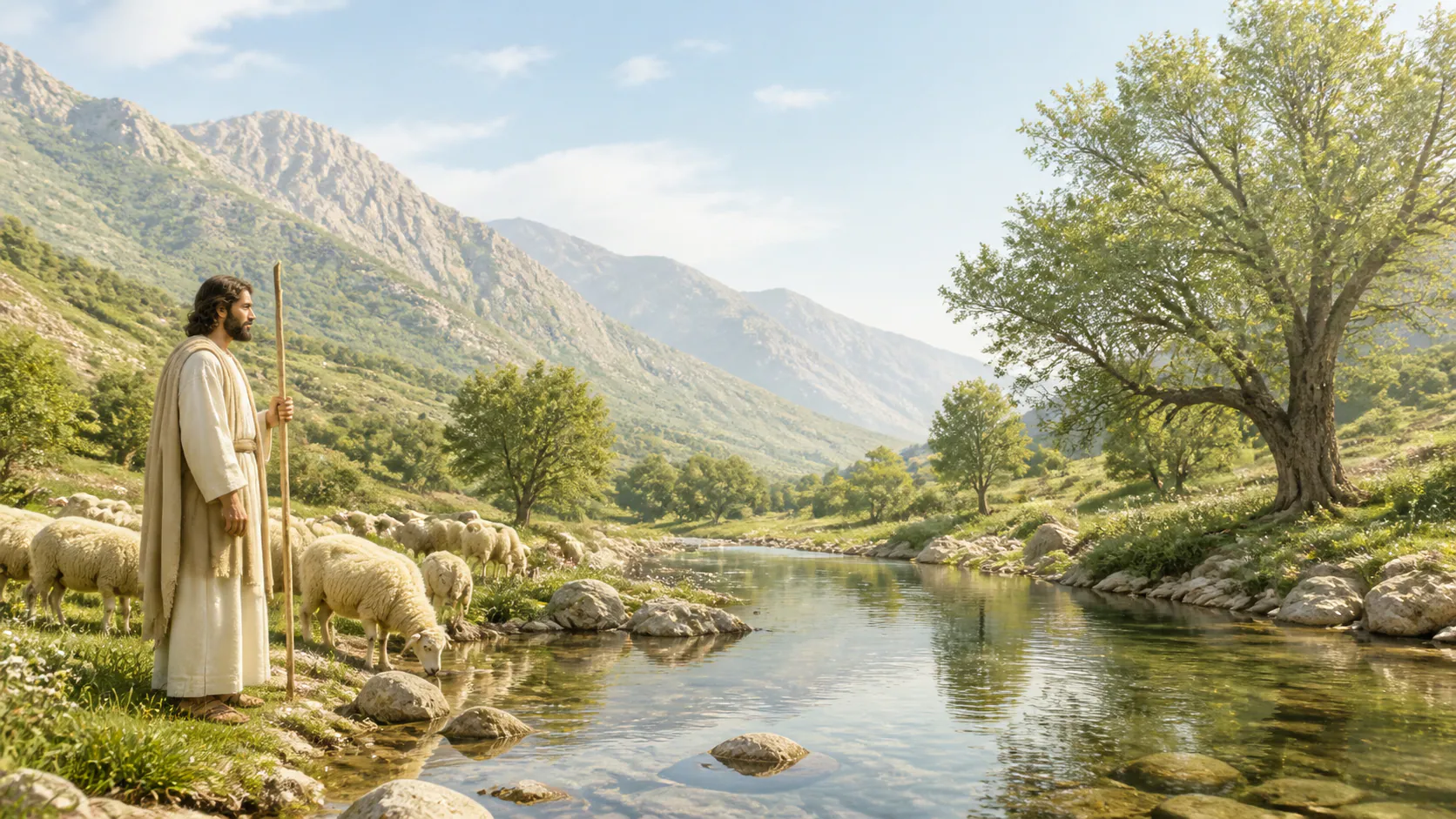
“This is the account of the heavens and the earth when they were created, when the LORD God made the earth and the heavens.” — Genesis 2:4 (NIV)
1. The Toledot of Heaven and Earth
Have you ever wondered why Genesis 2:4 describes the heavens and the earth as having generations?
The original Hebrew reads:
אֵלֶּה תוֹלְדוֹת הַשָּׁמַיִם וְהָאָרֶץ
Elleh toledot hashamayim veha'aretz.
The word toledot (תּוֹלְדוֹת) comes from the Hebrew root yalad, meaning to bear or bring forth.
Throughout Genesis, toledot introduces accounts associated with Adam, Noah, the sons of Noah, Terah, Isaac, and Jacob. It often tells us what comes forth from a person or family and what unfolds in their history.
But Genesis 2:4 is unusual.
It speaks not of the generations of a man, but of the generations of the heavens and the earth.
How can heaven and earth have generations?
Perhaps we should not think merely of biological descendants, but of the history that unfolds from YHWH's creation.
And this raises a deeper question.
What is the Creator of the universe inviting us to discover through this account?
2. What Is the Creator Trying to Tell Us?
Genesis begins with a majestic declaration:
“In the beginning God created the heavens and the earth.” — Genesis 1:1 (NIV)
Then Genesis 2:4 returns to the heavens and earth, but something interesting happens.
In the first half of the verse, the text reads:
Hashamayim veha'aretz — the heavens and the earth.
In the second half, he reverses the order:
Eretz veshamayim — earth and heavens.
Could this reversal draw our attention from the whole created universe toward what is about to unfold upon the earth?
The text does not explicitly explain the reversal. Yet the chapters that follow focus upon the ground, the human formed from it, and the garden where YHWH places him.
Perhaps the question is not merely how the universe came into existence.
Perhaps we should also ask:
What relationship does YHWH intend between heaven and earth, and what role has He entrusted to humanity?
To explore this, let us allow Scripture to explain Scripture.
3. Heaven and Earth: Two Realms Under One Sovereign
Listen carefully to the words of the psalmist:
“The highest heavens belong to the LORD, but the earth he has given to mankind.” — Psalm 115:16 (NIV)
What a remarkable declaration!
Heaven is associated with YHWH's throne and His heavenly host.
Earth has been entrusted to humanity.
In Genesis 1:26–28, YHWH creates humanity in His image and gives human beings responsibility to rule over living creatures and care for the world entrusted to them.
Does this mean humanity owns the earth independently of YHWH?
Certainly not!
Psalm 24:1 reminds us that the earth and everything in it belong to YHWH.
Humanity's dominion is therefore delegated stewardship, not absolute ownership.
Heaven and earth are distinct realms, yet both remain under the sovereignty of their one Creator.
YHWH reigns from heaven, while humanity is entrusted with responsibility upon the earth.
But this raises another question.
If YHWH reigns in heaven and humanity dwells upon earth, where do they meet?
4. Sacred Space: Where Heaven and Earth Meet
Let us return to Genesis 2.
YHWH plants a garden in Eden and places the human there.
This is no ordinary setting in the biblical story.
Here, YHWH gives His commands to the human. Here, humanity experiences His provision. And in Genesis 3, YHWH's presence is encountered in the garden.
After humanity's disobedience, cherubim are stationed to guard the way to the tree of life (Genesis 3:24).
Consider the significance.
The garden is located upon the earth, yet it is associated with the presence of the God of heaven.
Eden can be understood as sacred space—a place where the heavenly King meets His earthly servant.
Notice something else.
Genesis 2:15 tells us that YHWH places Adam in the garden to work it and take care of it.
The Hebrew uses two verbs:
Avad (עָבַד) — to work or serve.
Shamar (שָׁמַר) — to keep, watch over, or guard.
These same Hebrew roots later appear in descriptions of the Levites' service and responsibilities concerning the Tabernacle (Numbers 3:7–8).
Could Adam's responsibility in Eden carry a priestly dimension?
Genesis does not explicitly give Adam the title of priest. Nevertheless, the similarities invite us to consider Eden as more than a place of agricultural work.
Adam was entrusted with sacred responsibility in a place associated with YHWH's presence.
But Eden is not the last sacred dwelling place we encounter in Scripture.
5. From Eden to the Temple Within Us
Follow the progression of YHWH's dwelling among His people.
The Garden of Eden
YHWH places the human in sacred space, entrusting him with the responsibility to serve and guard.
The Tent of Meeting
In Exodus 33:7–11, Moses meets with YHWH at the tent of meeting, and the pillar of cloud marks the divine presence.
The Tabernacle
YHWH commands Israel:
“Then have them make a sanctuary for me, and I will dwell among them.” — Exodus 25:8 (NIV)
When the Tabernacle is completed, the glory of YHWH fills it (Exodus 40:34–35).
The Temple
When Solomon dedicates the Temple, the glory of YHWH fills the house (1 Kings 8:10–11).
Through these accounts, a beautiful theme develops.
The Creator of heaven and earth desires to dwell among His people.
But the story does not end with a sanctuary made by human hands.
Jesus speaks of His own body as the temple (John 2:19–21).
And through Him, the Holy Spirit comes to dwell in believers.
The apostle Paul declares:
“Do you not know that your bodies are temples of the Holy Spirit, who is in you, whom you have received from God?” — 1 Corinthians 6:19 (NIV)
Consider what this means.
The sacred-space theme that began in Eden develops through the Tabernacle and Temple, finds its fulfillment in Jesus Christ, and extends to those who belong to Him through the indwelling Holy Spirit.
Paul also teaches that believers together are God's temple (1 Corinthians 3:16–17).
The dwelling place of YHWH is no longer understood merely as a physical structure. His Spirit dwells within His people.
And if Adam was entrusted to serve and guard the sacred place, should we not also consider carefully how we live as those who have become temples of the Holy Spirit?
We are called to honor God with our bodies, to remain faithful to Him, and to reflect His holiness in our lives.
Yet another discovery awaits us.
What happens when YHWH's presence dwells in a place?
6. The River of Life: Blessings That Flow Outward
Return once again to Eden.
Genesis 2:10 tells us that a river flowed from Eden to water the garden, and from there it divided into four headwaters.
The garden receives water, but the river does not remain confined to the garden.
Now turn to Ezekiel 47.
The prophet sees water flowing from beneath the Temple.
At first, the water is shallow.
But as it flows farther, it becomes deeper and deeper until it forms a river that cannot be crossed on foot.
Wherever this river goes, life flourishes.
Trees grow along its banks.
They bear fruit for food, and their leaves serve for healing.
The water transforms even the waters of the Dead Sea, bringing life where there was barrenness.
What a beautiful prophetic picture!
Life flows outward from the sanctuary associated with YHWH's presence.
Now listen to Jesus in John 7:37–39.
He invites the thirsty to come to Him and drink, promising that rivers of living water will flow from those who believe in Him.
And John explains that Jesus was speaking about the Holy Spirit.
Do you see the connection?
In Genesis, a river flows from Eden.
In Ezekiel, water flows from the Temple.
In John's Gospel, living water flows from believers through the Spirit whom Jesus gives.
And in Revelation 22:1–2, we encounter the river of the water of life flowing from the throne of God and of the Lamb, with the tree of life bearing fruit and leaves for the healing of the nations.
These passages do not describe every river in precisely the same way. Yet together they present a remarkable biblical pattern:
Where YHWH gives life, His blessings are not meant to remain confined. They extend outward, bringing life, nourishment, fruitfulness, and healing.
Now consider the implication for us.
If our bodies are temples of the Holy Spirit, and the Holy Spirit is associated with living water, what should flow from our lives?
Should those around us not encounter love, joy, peace, patience, kindness, goodness, faithfulness, gentleness, and self-control—the fruit of the Spirit described in Galatians 5:22–23?
The water comes from YHWH.
The fruit comes through abiding in Christ.
We are neither the ultimate source of life nor the independent producers of spiritual fruit.
As Jesus teaches in John 15:5, branches bear fruit by remaining connected to the vine.
We receive life from Him so that our lives may become a blessing to others.
But is this principle limited to the imagery of gardens, rivers, and temples?
Let us examine the pattern of YHWH's covenant relationships.
7. The Divine Pattern: Blessed to Become a Blessing
When YHWH calls Abraham, He makes a remarkable promise.
“I will bless you ... and you will be a blessing.” — Genesis 12:2 (NIV)
And in Genesis 12:3, YHWH promises that all peoples on earth will be blessed through Abraham.
Notice the purpose.
Abraham is blessed, but the blessing does not end with Abraham.
It is intended to reach the nations.
Later, YHWH establishes His covenant with Israel and calls them to be a kingdom of priests and a holy nation (Exodus 19:5–6).
A priest serves before YHWH and represents His purposes among the people.
Israel's calling involves more than enjoying covenant privileges. They are entrusted with a holy vocation before the nations.
Then comes Jesus Christ.
Through His obedience, sacrifice, and resurrection, the promises of YHWH find their fulfillment.
Galatians 3:14 explains that through Christ Jesus, the blessing given to Abraham comes to the Gentiles, and believers receive the promised Spirit through faith.
And what does the Spirit produce?
Fruit.
Life.
Love.
A transformed heart.
The capacity to serve others according to the will of YHWH.
Can you see how the pattern develops across Scripture?
- Adam is entrusted with a sacred garden and a responsibility to serve and guard.
- Abraham receives a covenant promise through which all nations will be blessed.
- Israel is called into a covenant vocation as a priestly nation.
- Jesus Christ fulfills the covenant promises and becomes the source of life for His people.
- Believers receive the Holy Spirit and are called to bear fruit that blesses others.
These callings are not identical, and Adam's relationship with YHWH is not explicitly called a covenant in Genesis 2. Yet together they reveal a consistent principle:
YHWH calls people into relationship with Himself, entrusts them with His gifts, and works through them to bring blessing to others.
The recipient of the blessing is not necessarily its final destination.
The blessing is meant to bear fruit.
A tree does not consume its own fruit.
A river does not need to drink its own water.
And a believer should not live solely for the blessings he or she receives.
We are called to love YHWH and to love others.
Not because our good works purchase salvation, but because genuine faith in Christ produces a life transformed by His Spirit.
Three Questions for Our Lives
We began with a mysterious expression in Genesis 2:4:
“The generations of the heavens and the earth.”
From there, we explored heaven and earth, the sacred meeting place, Eden, the Tabernacle, the Temple, and the Holy Spirit dwelling within believers.
We followed the imagery of living water and fruitful trees.
And we discovered how YHWH repeatedly works through those He calls to bring blessings to others.
Now the question is no longer merely about Adam, Abraham, or ancient Israel.
The question is about you.
1. Have you entered into covenant with YHWH, the Creator of the universe?
Not merely knowing about Him.
Not merely attending religious gatherings.
But belonging to Him through faith in Jesus Christ, the mediator of the new covenant.
2. Have you become His temple, where His Holy Spirit dwells within you?
Have you received the new life He offers?
And are you honoring Him with the life and body entrusted to your care?
3. Have you become a spring through which His blessings flow to others?
Think about the people YHWH has placed around you.
Your spouse and children.
Your parents and relatives.
Your friends and coworkers.
Your neighbors and community.
Your nation.
Do they experience something of His love, mercy, kindness, truth, and goodness through their encounters with you?
Are they nourished by the fruit of the Spirit in your life?
Or have the blessings you received stopped with you?
Closing Reflection
Perhaps the greatest discovery in the toledot of the heavens and the earth is not merely that YHWH created two realms.
It is that the Creator desires to dwell among His people and bring His life into His creation.
From Eden to the Tabernacle.
From the Temple to Jesus Christ.
From Christ to His Spirit dwelling within believers.
And from believers outward, as His love and blessings reach the lives of others.
The garden receives the water, but the river flows outward.
The branch receives life from the vine, but its fruit nourishes others.
We receive the Holy Spirit, and our lives are called to bear His fruit.
May we never forget that the life comes from YHWH, the Creator of heaven and earth.
And may those who encounter us experience the blessings of the One who dwells within us.
We are blessed so that we may become a blessing.
“May God be gracious to us and bless us and make his face shine on us—so that your ways may be known on earth, your salvation among all nations.”
— Psalm 67:1–2 (NIV)