
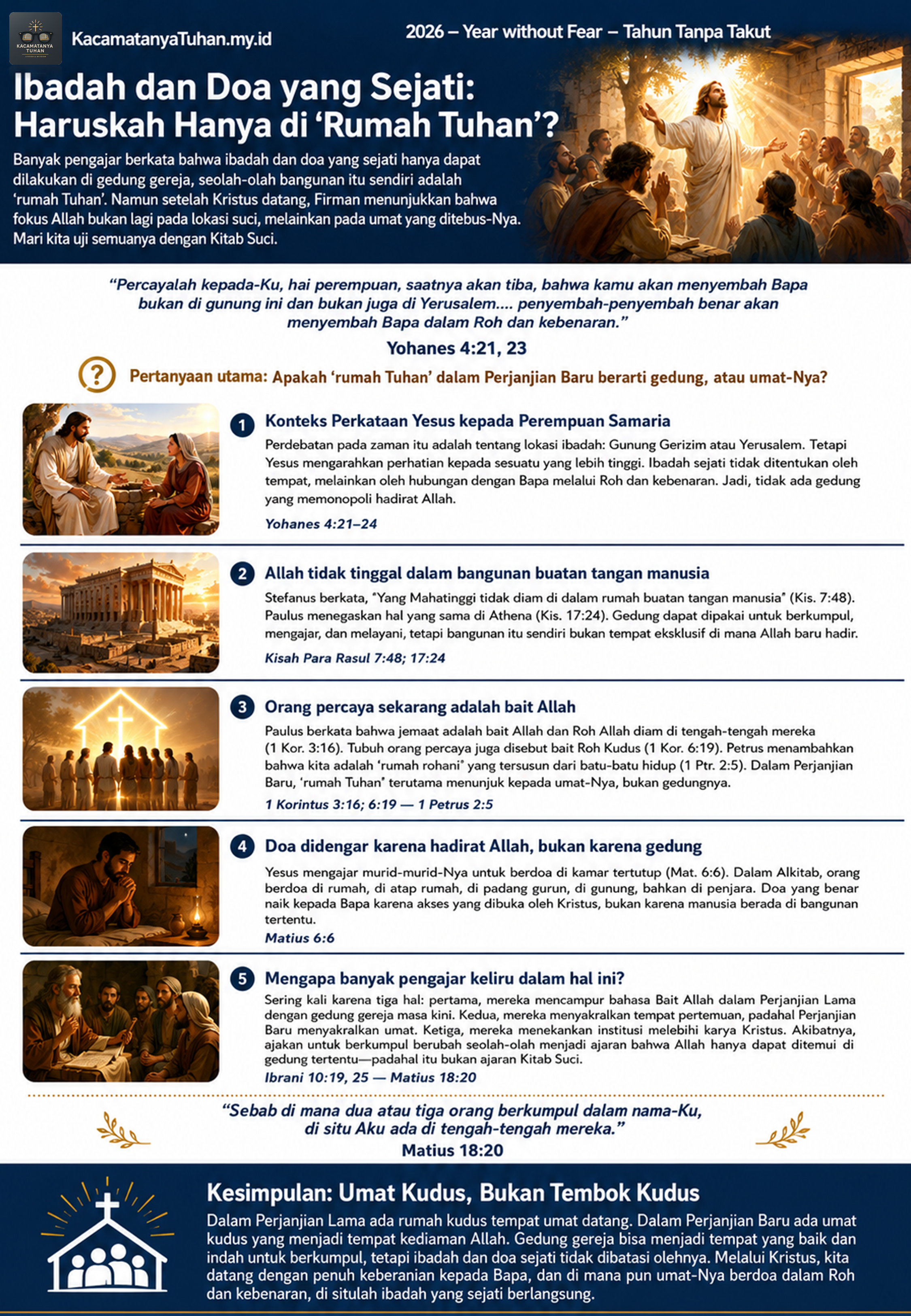
Complete English translation
“Believe Me, woman, a time is coming when you will worship the Father neither on this mountain nor in Jerusalem. Yet a time is coming and has now come when the true worshipers will worship the Father in the Spirit and in truth.” — John 4:21, 23
The central question is this: in the New Testament, does the “house of God” mean a building, or does it mean God’s people?
1. The context of Jesus’ words to the Samaritan woman
The dispute of that day concerned the proper location of worship: Mount Gerizim or Jerusalem. Jesus directed attention to something higher. True worship is not determined by a place, but by a relationship with the Father through the Spirit and truth. No building, therefore, has a monopoly on the presence of God (John 4:21–24).
2. God does not live in buildings made by human hands
Stephen said, “The Most High does not live in houses made by human hands” (Acts 7:48). Paul taught the same truth in Athens (Acts 17:24). A building can serve as a valuable place to gather, teach, and minister, but the building itself is not an exclusive place where God alone can be present.
3. Believers are now God’s temple
Paul says that the gathered church is God’s temple and that God’s Spirit dwells among them (1 Corinthians 3:16). The believer’s body is also called a temple of the Holy Spirit (1 Corinthians 6:19). Peter adds that we are a “spiritual house” made of living stones (1 Peter 2:5). In the New Testament, the “house of God” points primarily to His people, not to their building.
4. Prayer is heard because of God’s presence, not because of a building
Jesus taught His disciples to pray in a private room (Matthew 6:6). Throughout Scripture, people pray in homes, on rooftops, in the wilderness, on mountains, and even in prison. True prayer reaches the Father because Christ has opened the way—not because the person praying is inside a particular building.
5. Why do many teachers misunderstand this?
Three confusions often lie behind it. First, Old Testament temple language is applied directly to a modern church building. Second, the meeting place is treated as sacred, although the New Testament sets apart God’s people as holy. Third, the institution is emphasized above the work of Christ. As a result, the biblical call to gather is turned into a claim that God can be encountered only in a particular building—but Scripture does not teach this (Hebrews 10:19, 25; Matthew 18:20).
“For where two or three gather in My name, there am I with them.” — Matthew 18:20
Conclusion: A Holy People, Not Holy Walls
Under the old covenant there was a holy house to which the people came. Under the new covenant there is a holy people who have become God’s dwelling place. A church building can be a good and beautiful place to gather, but true worship and prayer are not confined to it. Through Christ we come boldly to the Father; wherever His people pray in the Spirit and in truth, true worship is taking place.