

Complete English translation
Deuteronomy 6:4 affirms that GOD is one. Isaiah 44:24 also states that YHWH spread the heavens and spread the earth. But the question that needs to be tested from all the testimony of the Holy Scriptures is: does "God is one" automatically mean "God is only one person"?
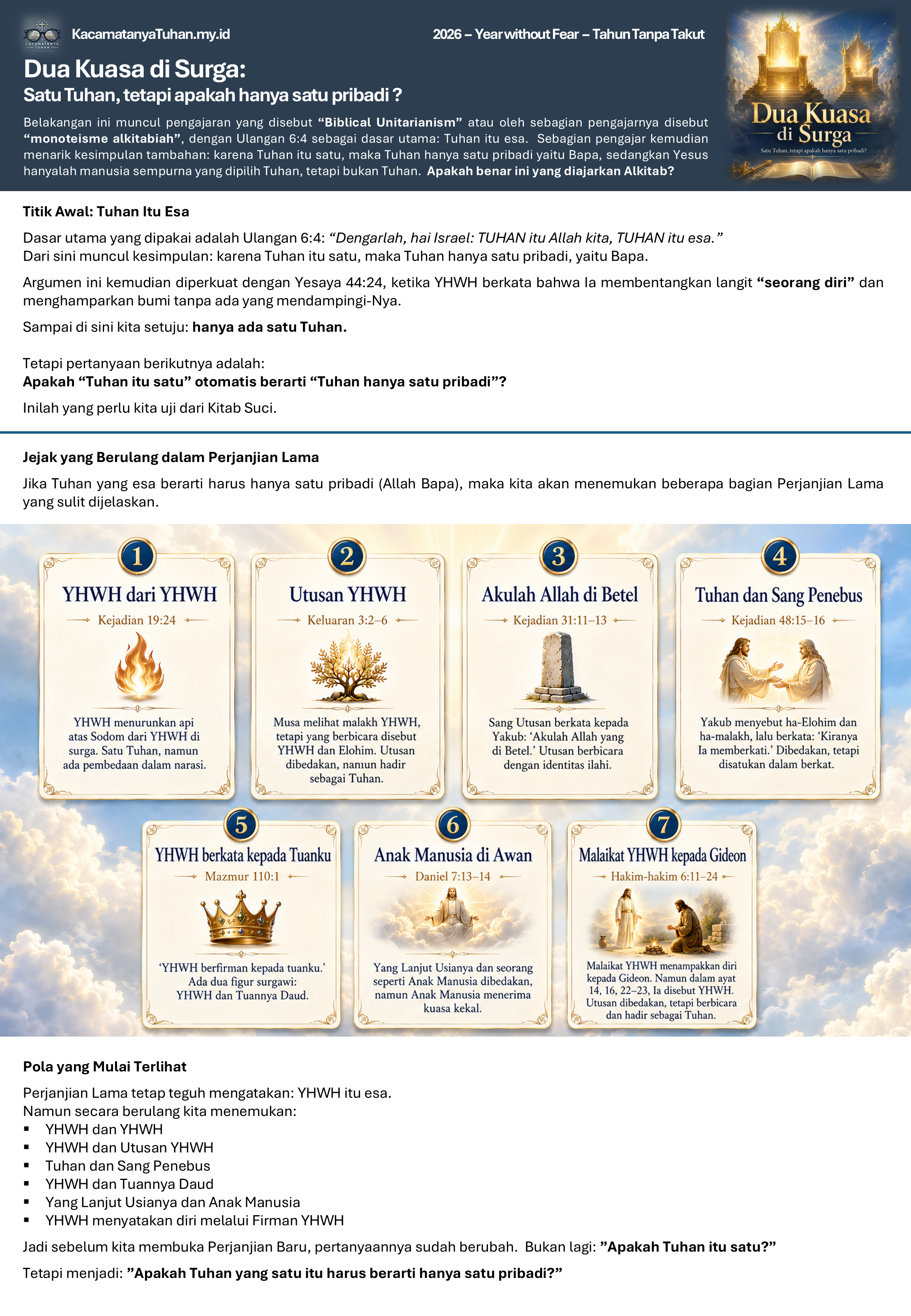
The Old Testament repeatedly shows the distinction in the divine narrative:
- YHWH from YHWH — Genesis 19:24
- The messenger of YHWH who spoke as YHWH — Exodus 3:2–6
- "I am God in Bethel" — Genesis 31:11–13
- God and the Redeemer — Isaiah 48:15–16
- "YHWH spoke to my Lord" — Psalm 110:1
- Son of Man in the clouds — Daniel 7:13–14
- The angel of YHWH to Gideon — Judges 6:11–24
The New Testament explains the pattern more clearly. The word is God and becomes man (John 1:1, 14, 18). The texts about YHWH were applied to Jesus (Isaiah 40:3; Mark 1:2–3; Joel 2:32; Romans 10:9–13). Jesus did God's work and received divine honor (Colossians 1:16–17; Hebrews 1:6, 8–12; Philippians 2:9–11; Revelation 5).
At the same time, the Father and the Son are still distinguished. The Son comes from the Father, sent by the Father, declares the Father, does the Father's work, and submits to the Father (John 14:28; John 5:26; 1 Corinthians 15:24–28).
The Bible does not introduce two Gods. But the Bible also does not allow us to reduce the oneness of God to one person alone. The Father and the Son are really distinguished, but the New Testament includes the Son in the work, honor, name, and identity of YHWH.
The conclusion: God is one. The Father and the Son are distinguished, and the Son still has a divine identity. The oneness of God does not have to mean only one person—one God, with the distinction between the Father and the Son.
"But for us there is only one God, the Father, from whom all things come and for him we live, and one God alone, Jesus Christ, through whom all things were made and through whom we live." — 1 Corinthians 8:6