
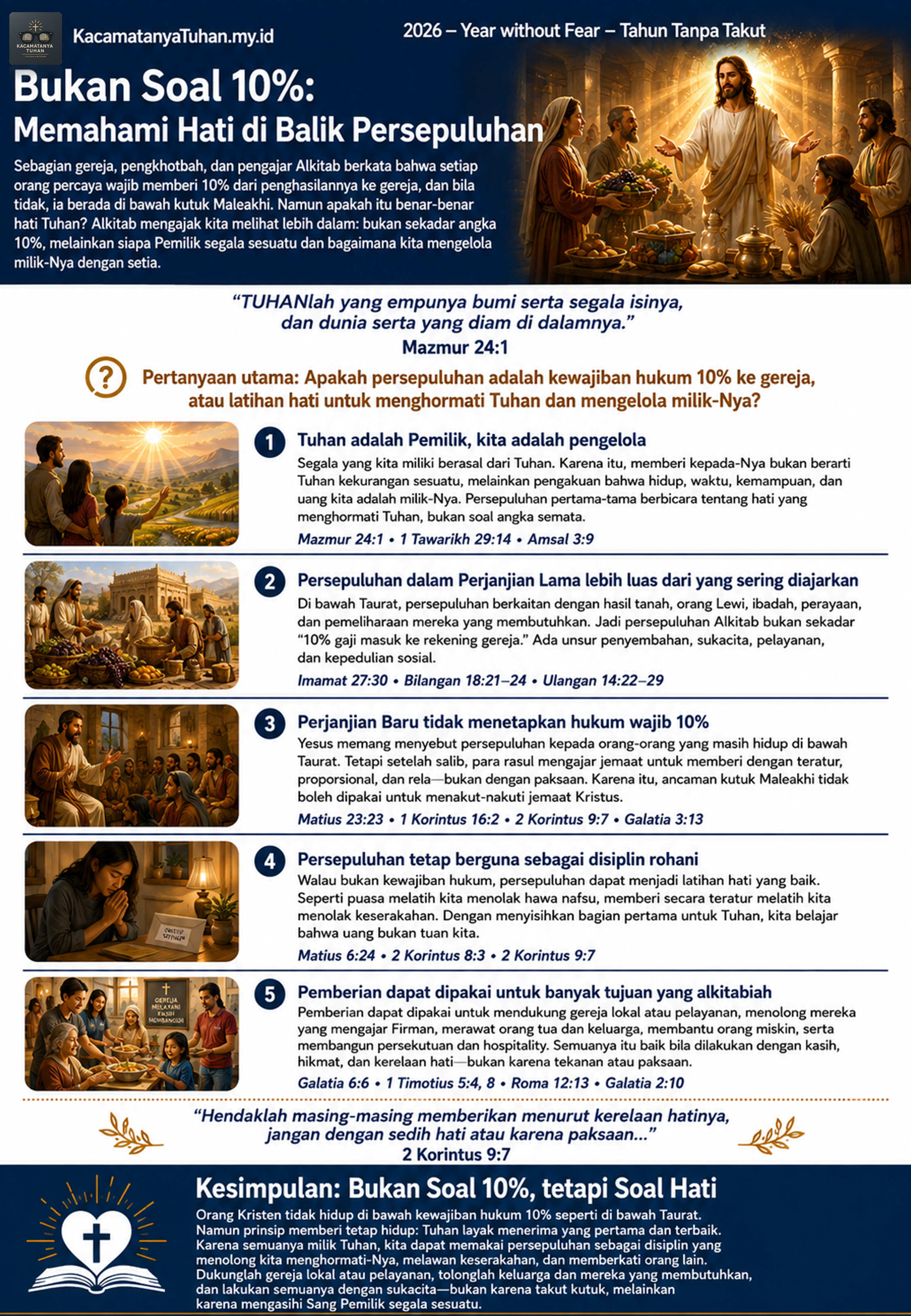
Complete English translation
“The earth is the LORD’s, and everything in it, the world, and all who live in it.” — Psalm 24:1
The central question is this: is tithing a legal obligation to give 10% to a church, or can it be a discipline of the heart through which we honor God and steward what belongs to Him?
1. God is the Owner; we are stewards
Everything we possess comes from God. Giving to Him does not mean that God lacks something; it is our acknowledgment that our life, time, abilities, and money belong to Him. Tithing begins with a heart that honors God, not with a number alone (Psalm 24:1; 1 Chronicles 29:14; Proverbs 3:9).
2. Tithing under the old covenant was broader than it is often presented
Under the Law, tithes were connected with produce from the land, the Levites, worship, festivals, and care for people in need. Biblical tithing was therefore more than “10% of a salary deposited into a church account.” It included worship, joy, ministry, and social care (Leviticus 27:30; Numbers 18:21–24; Deuteronomy 14:22–29).
3. The New Testament does not establish a compulsory 10% law
Jesus mentioned tithing when speaking to people who still lived under the Law. After the cross, however, the apostles taught churches to give regularly, proportionately, and willingly—not under compulsion. Malachi’s warning about a curse should therefore not be used to frighten Christ’s people (Matthew 23:23; 1 Corinthians 16:2; 2 Corinthians 9:7; Galatians 3:13).
4. Tithing can still be useful as a spiritual discipline
Although it is not a legal obligation, setting aside a portion regularly can train the heart well. As fasting teaches us to resist appetite, regular giving trains us to resist greed. By setting aside the first portion for God, we learn that money is not our master (Matthew 6:24; 2 Corinthians 8:3; 2 Corinthians 9:7).
5. Giving can serve many biblical purposes
Giving may support a local church or ministry, help those who teach the Word, care for parents and family, relieve the poor, and cultivate fellowship and hospitality. These are all good when they are practiced with love, wisdom, and willingness—not pressure or coercion (Galatians 6:6; 1 Timothy 5:4, 8; Romans 12:13; Galatians 2:10).
“Each of you should give what you have decided in your heart to give, not reluctantly or under compulsion...” — 2 Corinthians 9:7
Conclusion: Not About 10%, but About the Heart
Christians do not live under the old-covenant legal requirement of 10%. Yet the principle of giving remains alive: God is worthy of our first and best. Because everything belongs to Him, we may use a tithe as a discipline that helps us honor Him, resist greed, and bless others. Support your local church or ministry, care for family and people in need, and do it all joyfully—not from fear of a curse, but from love for the Owner of everything.