
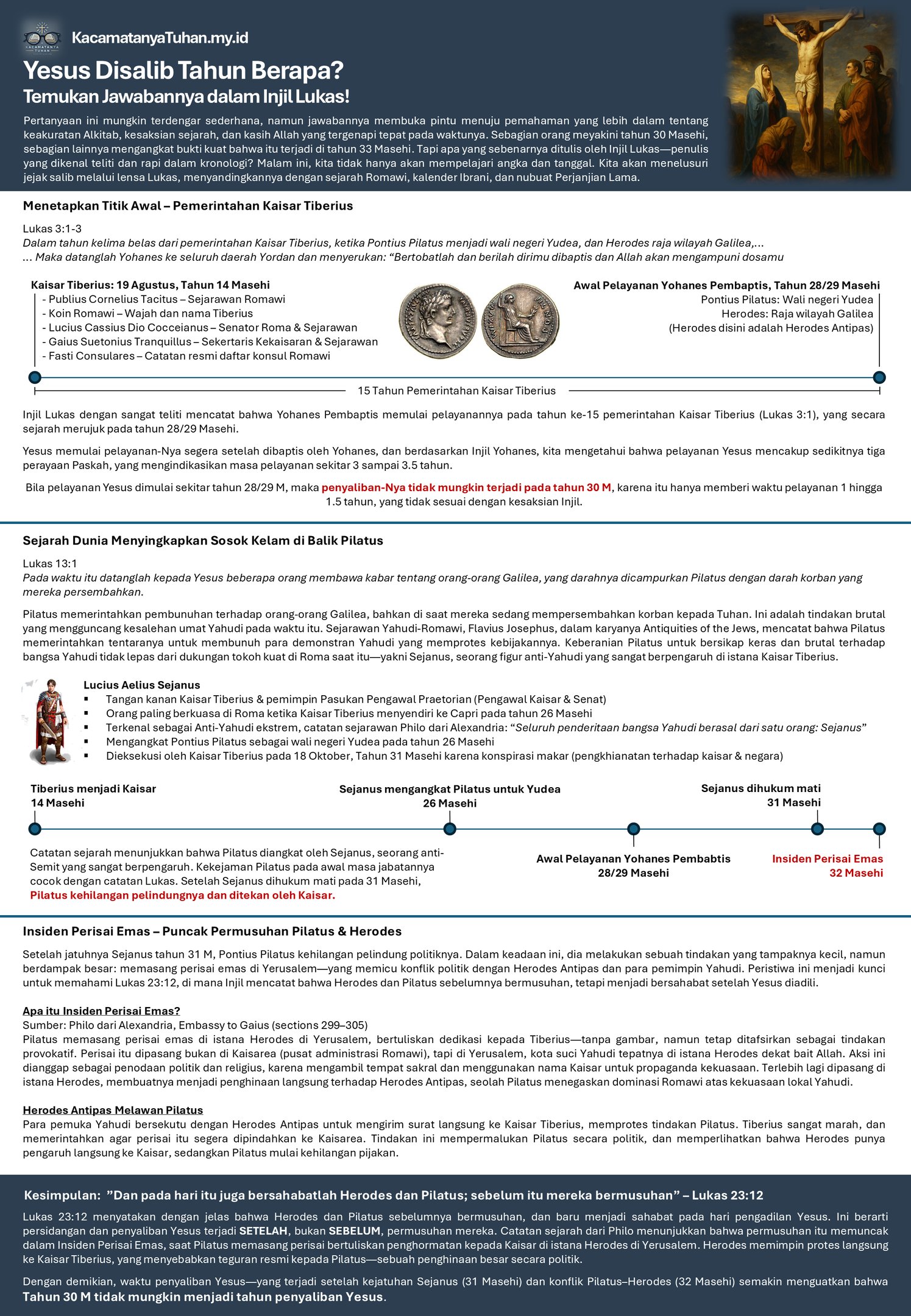
Complete English translation
📍 Point 1: Determining the Starting Point - The 15th Year of Emperor Tiberius & The Beginning of Jesus' Service
Let's start with something very concrete—history.
The Gospel of Luke, the author who is known to be the most thorough in organizing events, opens chapter 3 with a very specific time marker:
Luke 3:1-3
"In the fifteenth year of the reign of Emperor Tiberius, when Pontius Pilate became governor of Judea, and Herod was the king of Galilee... Then John came throughout the Jordan region and called out: 'Repent and be baptized and God will forgive your sins.'"
This verse is not just a narrative background—it is a chronological foothold that can be historically verified. We can trace the year not only through the Bible, but also through the records of Roman historians and archaeological evidence.
🏛️ When is the 15th Year of Tiberius?
Some historical sources state that Emperor Tiberius officially began to rule on August 19, 14 AD, after the death of Emperor Augustus. The source is very rich:
Tacitus, a critical and detailed Roman historian.
Cassius Dio, senator and author of Roman History.
Suetonius, imperial secretary and author of The Twelve Caesars.
Roman coins from that era — print the image and name of Tiberius with the title Pontifex Maximus.
Fasti Consulares — the official list of consuls every year in the Roman calendar system.
If the first year of Tiberius began in 14 AD, then the 15th year is 28/29 AD. It was in this year that John the Baptist appeared and began to preach in Judea.
📖 Who are the Characters Called Luke?
Luke recorded very accurately who was in power at that time:
Pontius Pilatus as governor of Judea (26–36 AD).
Herod as the king of Galilee — this is Herod Antipas, not Herod the Great. Antipas ruled from 4 BC–39 AD.
The presence of these names makes us know: Luke is making a historical record that can be tested, not a fairy tale.
✝️ What is the Relevance to the Ministry of Jesus?
After John appeared and baptized Jesus, Jesus began His ministry. The Gospel of John records that during His ministry, Jesus attended at least three Jewish Passovers (John 2:13, 6:4, 11:55), even a possibility of four if John 5:1 also refers to the Passover.
👉 This shows that Jesus' ministry lasted for about 3 to 3.5 years.
So if His ministry began around the year 28 or 29 AD, then:
30 AD is too early to be the year of crucifixion.
The new crucifixion logically occurred in 33 AD, because only that year gave enough room for full ministry—as recorded in the four Gospels.
✅ Conclusion of Point 1
The Gospel of Luke with historical precision establishes the beginning of the ministry of John the Baptist in the 15th year of Tiberius, which is the year 28/29 AD. With the ministry of Jesus lasting 3.5 years, His crucifixion could not have happened in 30 AD, but most precisely in the year 33 AD.
⚔️ Point 2: World History Reveals the Dark Figure Behind Pilatus
After we have set the beginning of the ministry of Jesus based on Luke 3, now we open the page of world history to see: who exactly was Pilate, and why was he so cruel to the Jews?
The answer is not only in the Bible, but also behind the political scenes of the Roman Empire.
📖 Luke 13:1 – Shadow of Dark Power
"At that time some people came to Jesus to bring news of the Galileans, whose blood was mixed with Pilate with the blood of the sacrifices they offered."
A terrible event. Pilate ordered the massacre of the Galileans while they were offering sacrifices before God. This is not just ordinary cruelty—this is a deep spiritual desemy.
🏛️ Historical Records Strengthen the Testimony of the Gospel
Historian Flavius Josephus, in Antiquities of the Jews, notes that Pilate ordered his soldiers to kill Jewish demonstrators who protested against his policies, even using civil-clothed agents to beat and kill them abruptly.
Where did Pilate get the courage to act so brutally against the Jews?
🧨 Lucius Aelius Sejanus - The Emperor's Right Hand, Enemy of the Covenant
This is a figure that is rarely discussed in the church, but it is very important for us to understand.
Sejanus was the head of the Praetorian Guard, the right-hand man of Emperor Tiberius, and the de facto ruler of the Empire when Tiberius setled to the island of Capri in 26 AD.
He is known as an extreme anti-Jewish. Even Philo of Alexandria wrote:
"All the suffering that befell the Jews at that time came from one person: Sejanus."
It was Sejanus who appointed Pontius Pilate to be the governor of Judea in 26 AD, as part of his loyalist network.
During the protection of Sejanus, Pilate acted arbitrarily against the Jews — this is consistent with Luke 13:1 and Josephus's account.
🔥 Turning Point: The Fall of Sejanus and the fragility of Pilatus
But on October 18, 31 AD, Sejanus was sentenced to death by Emperor Tiberius for treason conspiracy.
After that:
Tiberius revoked all the power of the people who had previously been protected by Sejanus.
Including Pilate, who lost his political protector and became weak in position and reputation.
📅 Chronological Series:
Year of Event
14 M Tiberius ascended the throne
26 A.D. Sejanus appointed Pilatus
31 AD Sejanus was sentenced to death
32 AD Gold Shield Incident (Pilate reported to the Emperor by Herod)
33 AD Jesus was judged by Pilate
✅ Conclusion Point 2
Historical records show that Pilate's cruelty in the early days of his term could not be separated from the political protection of Sejanus, a very powerful anti-Semitic figure. But after Sejanus was executed in 31 AD, Pilate became politically depressed, losing his authority and influence.
This is Pilate's condition when Jesus was tried: afraid, trapped, and no longer dared to take risks against the pressure of the Jewish leaders. All of this fits the Gospel image and leads to one big conclusion: the crucifixion of Jesus most likely occurred in 33 AD, not before.
🛡️ Point 3: Gold Shield Incident - The Peak of Pilate & Herod's Hostility
After the fall of Sejanus in 31 AD, Pontius Pilatus no longer had a political patron in Rome. This made his position fragile, and every action in Judea was now under the direct supervision of Emperor Tiberius.
In this situation, Pilate did something that was visible to the eye, but had a big and wide impact: he put up a golden shield in Jerusalem.
🛑 What is the Gold Shield Incident?
The historical record of Philo of Alexandria (Embassy to Gaius, §299–305) explains that:
Pilate installed a golden shield in Herod's palace in Jerusalem.
There is no picture, but there is a dedication to Emperor Tiberius—who politically contains a very strong symbolic content.
This shield was not placed in Caesarea (the center of Roman administration), but in Jerusalem, the holy city for the Jews.
The location is right in Herod's palace, which is symbolically a local Jewish territory.
In other words, Pilate was sending a message: "Roman power is higher than local authority."
A direct insult to Herod Antipas.
⚔️ Herod Antipas Responds – and Wins
This action of Pilate not only humiliated Herod, but also sparked the anger of the Jewish leaders.
They didn't stay silent:
Herod and the Jewish leaders united, sending an official letter directly to Emperor Tiberius to protest Pilate's action.
Emperor Tiberius responded seriously. He was angry, and ordered that the shield be moved to Caesarea immediately.
This was a hard diplomatic blow to Pilate, and showed that Herod had a stronger influence over Rome than Pilate.
📖 Luke 23:12 – The Gospel Connected with History
"On that day were also friends with Herod and Pilate; before they were enemies." – Luke 23:12
The Gospel of Luke is the only one that records that Pilate and Herod had a bad relationship before.
With the historical background of Philo, we now understand why they are hostile:
The Golden Shield Incident was the peak of their conflict.
Pilate insulted Herod's authority in the land of the Jews.
Herod retaliated with a diplomatic strategy directly to the Emperor, and won.
However, when Jesus was brought to Herod and then returned to Pilate (Luke 23:6–11), the two of them made peace.
A great irony: The holy Messiah is used as a compromise tool for two world rulers who were previously at odds.
✅ Conclusion Point 3
The Golden Shield Incident became the culmination of the hostility between Herod Antipas and Pontius Pilatus. By placing the imperial symbol in Herod's court, Pilate insulted the local authority of the Jews. Herod retaliated by taking advantage of the direct route to Caesar, and succeeded in humiliating Pilate.
Luke 23:12 is not only a personal record of relations, but a confirmation of history: that Jesus was tried after this great political conflict, not before.
This reinforces that the crucifixion of Jesus occurred after the year 31 AD, which is the year 33 AD, when the political situation of Herod and Pilate had changed.
✅ Final Conclusion - Historical Evidence Confirming the Gospel
"And on that day were also friends with Herod and Pilate; before that they were enemies."
- Luke 23:12
This verse is not only a social detail, but a strong chronological key. Luke clearly notes that Herod and Pilate only reconciled on the day Jesus was tried, meaning that Jesus' trial took place after their hostility.
And history confirms it.
Through the records of Philo of Alexandria, we see that the hostility culminated in the Golden Shield Incident — when Pilate boldly set up a shield of honor for the Emperor at Herod's court in Jerusalem. Herod did not stay silent. He led a direct protest to Emperor Tiberius, and managed to make Pilatus officially reprimanded, a great disgrace for a Roman governor.
This happened in 32 AD, one year after the fall of Sejanus (31 AD)—Pilate's political protection that allowed him to act cruelly before.
Thus, it is very clear that:
The hostility of Herod and Pilate occurred between 31–32 AD
Jesus was tried and crucified after they made peace
So, the crucifixion of Jesus could not have happened in the year 30 AD
The year 33 AD is the most suitable time, both with the testimony of the Gospel of Luke, and the records of world history.