
Complete English translation
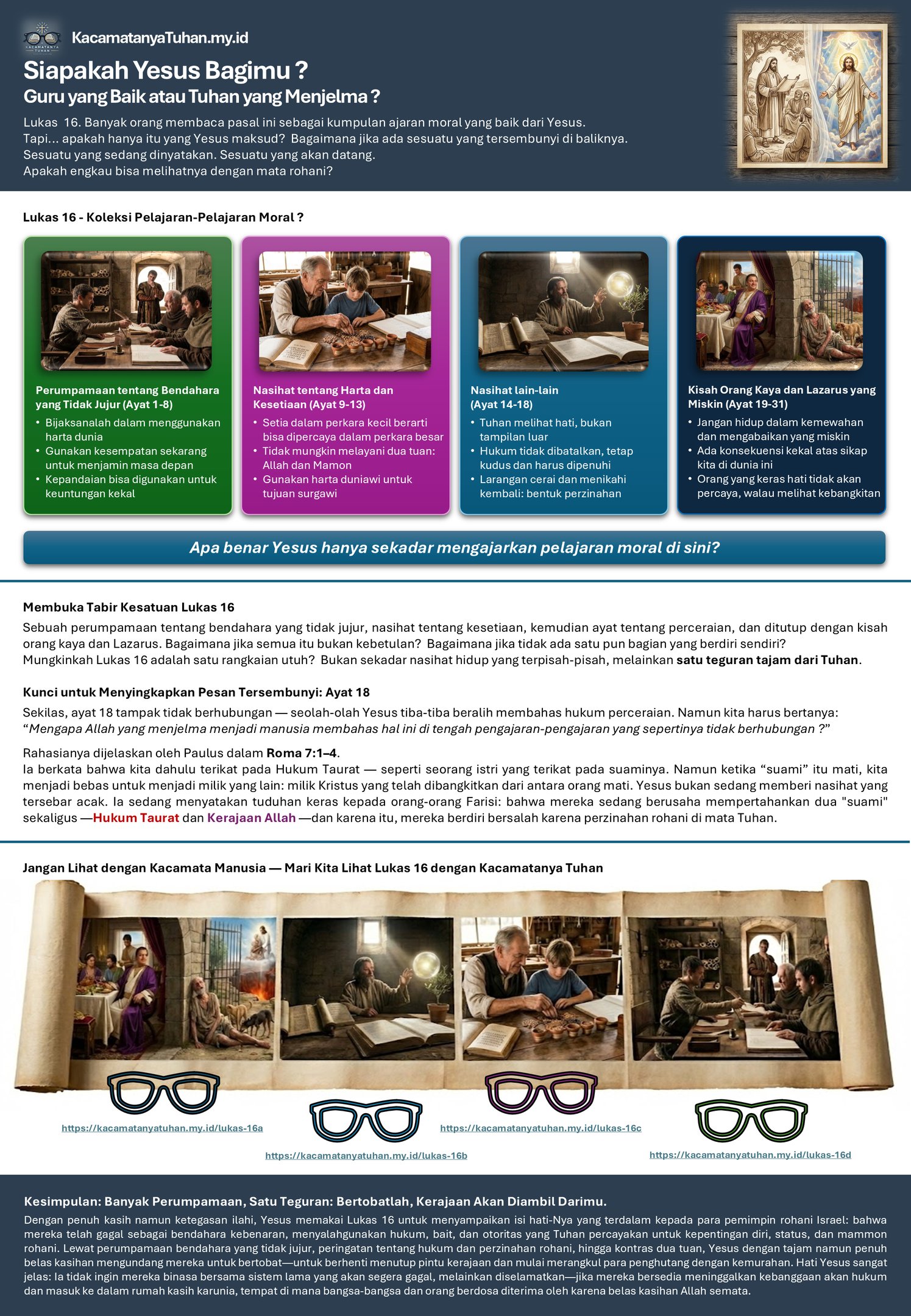
📜 Hidden Structure in Luke 16
Yeshua said:
The parable of the Dishonest Treasurer (ay. 1–8)
Advice about Mammon and Loyalty (ay. 9–13)
Rebuke about the Torah and Divorce (ay. 14-18)
The Story of the Rich Man and Lazarus (ay. 19–31)
These are not four separate teachings. This is a series of reprimands—delivered in a very deliberate order and full of divine meaning.
🔍 Rabbinik Glasses: What is the Common Thread?
1. Verses 1–8: Reprimand for Corrupt Leaders
Dishonest treasurers reflect Israeli leaders who:
Abuse of authority,
Exchanging eternity for worldly benefits,
Still given the opportunity to use his position to welcome the coming kingdom.
Yeshua is not teaching financial tactics. He is revealing that spiritual leaders have failed to protect God's house.
2. Verses 9–13: God or Mammon?
"It is impossible for you to serve Allah and Mammon."
This is not just a teaching about money. This is a confrontation against the motivation of the clergy who love status, wealth, and human praise. They cannot be the leaders of the people and servants of wealth.
3. Verse 14–18: Torah and Divorce
Suddenly Jesus talks about the law and divorce—it doesn't seem to connect. But this is the pinnacle of spiritual satire:
Keywords: "Therefore, whoever divorces his wife and marries another, commits adultery."
This is a spiritual metaphor.
As Paul explained (Romans 7:1–4), the Israelites were "bound" to their first husband: the Law.
But now, the "husband" is dead (crucified with Christ). But the Pharisees refused to "marry" the Messiah, they wanted to stay with the Torah and enter the Kingdom. So they committed adultery—spiritually.
4. Verses 19–31: Lazarus and the Rich Man
This story is the conclusion of the whole chapter:
The rich = the symbol of Israel who is stubborn, enjoying spiritual luxury, but does not care about "Lazarus" — spiritually poor nations.
Lazarus = a non-Jewish people who are despicable according to the world, but exalted in the Kingdom because they believe and hope in God.
When the "rich man" dies, he is not taken by the angel—that is, without faith.
Lazarus, on the other hand, was taken to Abraham's lap—because he was the son of the true covenant.
🔥 Big Conclusion: Many Parables, One Reprimand
Everything written in Luke 16 is not a collection of moral teachings. It was a prophetic rebuke from God himself, to the leaders of Israel:
"Repent, because the Kingdom of God will be taken from you and given to other nations that want to bear fruit."
Jesus did not come only as a moral teacher. He comes as a God who admonishes — reveals spiritual blindness, denounces hypocrisy, and announces the transfer of spiritual power from those who only care about status and law, to those who live by faith.
📖 Cover: God's Glasses vs Human Glasses
"Do not look as men look, because men see what is in front of their eyes, but God sees the heart."
– 1 Samuel 16:7
If we only look at Luke 16 as a moral teaching, we have read with human glasses. But if we see that Jesus is revealing his spiritual blindness and calling for repentance before it's too late—then we start reading with God's Glasses.