
Complete English translation
The ancient Jewish wedding tradition is not only an interesting cultural practice, but also reflects God's divine plan for His people. This tradition is filled with rich symbolism and designed with certain intentions, giving an extraordinary picture of the relationship between Jesus Christ and His Church.
One of the most interesting aspects of this tradition is how the tradition reflects the story of redemption, from engagement to wedding parties. Every stage—giving a dowry, the groom's preparation, the bride's waiting, and the bride's sudden arrival—depicts a deeper spiritual truth.
For believers, understanding these similarities provides a new understanding of familiar Bible verses, helping us see how Jesus' promises are in harmony with this ancient tradition. In this article, we will discuss the steps of traditional Jewish marriage and reveal its relationship with the greatest love story: the union between Christ and His bride. Let's start by looking at the first step—engagement and dowry.
Engagement and Marriage
In ancient Jewish marriage, engagement (kiddushin) is a legal agreement in which the groom is committed to the bride. This commitment is marked by the giving of a dowry, or mohar, by the groom or his father. This dowry symbolizes the groom's appreciation to the bride and provides a guarantee of his safety, even if unexpected things happen.
In spiritual parallel, Jesus gave dowry to His bride, namely the Church, through the gift of the Holy Spirit. The Holy Spirit is described as a guarantee or advance payment of our inheritance, a sign of God's covenant with His people (Ephesians 1:13-14, 2 Corinthians 1:21-22). Just as the dowry is the promise of the bridegroom's intention to fulfill marriage, the Holy Spirit convinces believers of the return of Christ and the completion of our union with Him.
This stage highlights how much the price of redemption is, showing how much God values His people and is committed to their eternal security.
Groom's Preparation
After the engagement, the groom will return to his father's house to prepare a place for the bride. This often involves the construction of an additional room or residence that the couple will use. The groom's focus during this time is to make sure everything is ready for their future together.
In the same way, Jesus said to His disciples, "In My Father's house there are many dwelling places. If not, I would have told you. Because I went there to prepare a place for you. And when I have gone there and have prepared a place for you, I will come back and take you to My place, so that where I am, you may be" (John 14:2-3). This promise reflects the role of the groom in Jewish marriage and Jesus' assurance of eternal life with Him.
This preparation period emphasizes the dedication and love of the groom to the bride. In addition, this period also requires patience and loyalty from the bride who is waiting for her arrival. For believers, this is a reminder to stay vigilant and faithful while waiting for Christ's return (Matthew 24:42-44).
Sudden Arrival
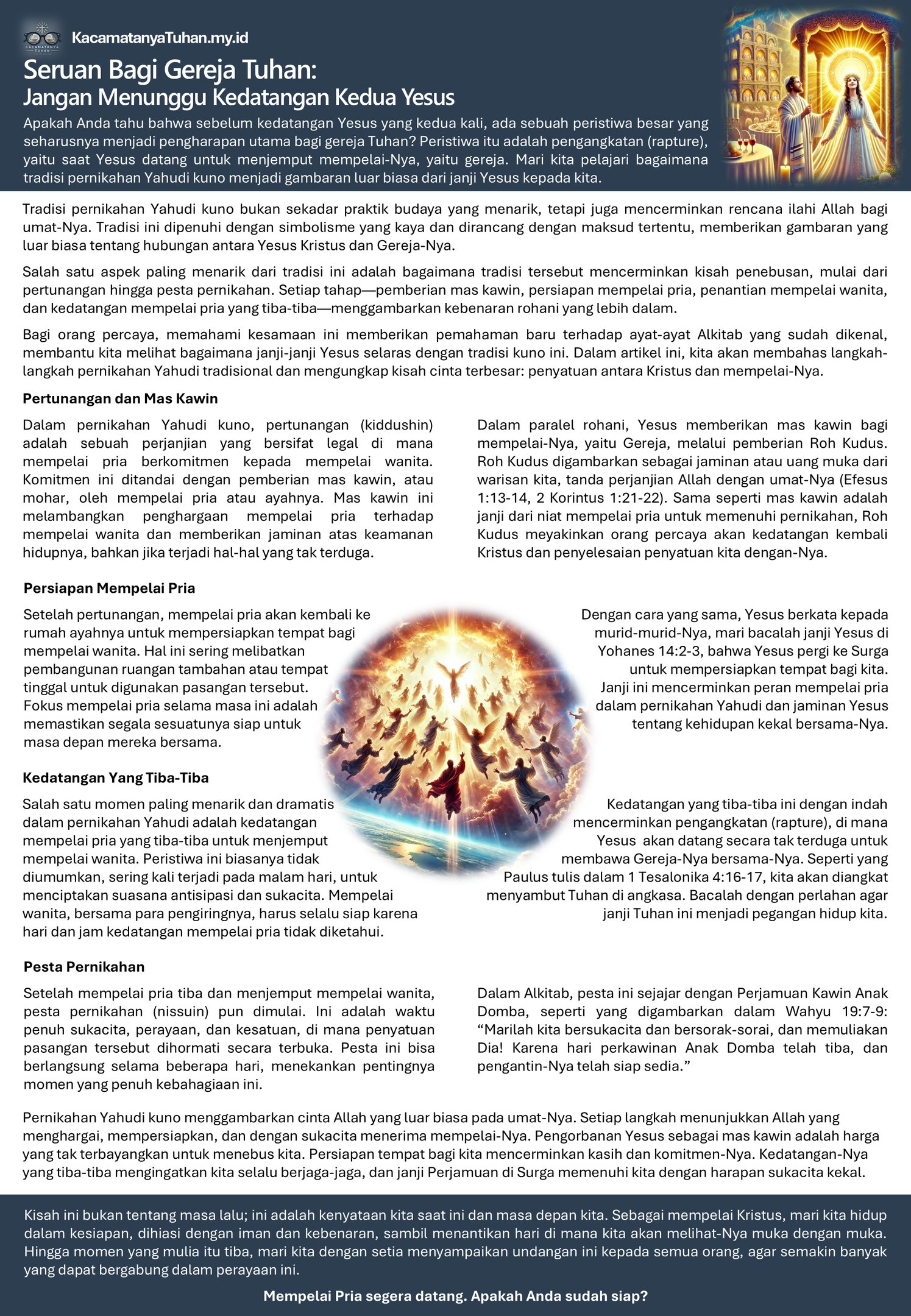
One of the most interesting and dramatic moments in a Jewish wedding is the sudden arrival of the groom to pick up the bride. This event is usually not announced, often occurs at night, to create an atmosphere of anticipation and joy. The bride, along with her attendants, must always be ready because the day and time of the groom's arrival are unknown.
This sudden arrival beautifully reflects the rapture, where Jesus will come unexpectedly to bring His Church with Him. As Paul wrote in 1 Thessalonians 4:16-17, "For the Lord himself will come down from heaven with a loud command, with the voice of angels and the trumpet of God, and those who die in Christ will rise first. After that, we who are still alive, who are still alive, will be taken up together with them in the clouds to meet God in space. Thus we will forever be together with God."
Jesus also mentioned this in Matthew 24:36, by saying, "But about that day and hour no one knows, neither the angels in heaven, nor the Son, only the Father himself." This is in line with Jewish tradition where the groom's arrival time is determined by his father.
For believers, this is a call to always be ready and loyal. Just as the bride who waits with joyful anticipation, we are also called to live in the hope of the coming of Christ, ready to meet Him at any time (Matthew 25:1-13).
Wedding Party
After the groom arrives and picks up the bride, the wedding party (nissuin) begins. This is a time full of joy, celebration, and unity, where the union of the couple is publicly respected. This party can last for several days, emphasizing the importance of this happy moment.
In the Bible, this feast is parallel to the Lamb's Marriage Supper, as described in Revelation 19:7-9: "Let us rejoice and shout, and glorify Him! Because the wedding day of the Lamb has come, and His bride is ready. And he was given to wear a smooth linen cloth that was shiny and pure white."
This glorious event celebrates the unification of Christ and His Church, marking the fulfillment of God's promises and the culmination of His redemption plan. Fine linen symbolizes the righteous deeds of the saints, as a proof of their loyalty and the grace of God.
This wedding feast reminds believers of the joy and eternal fellowship that awaits those who remain faithful to Christ. It is also a call to invite others to this celebration, as Jesus taught in the parable about the great supper (Luke 14:16-24). Just as the party in Jewish marriage is a time of inclusion and joy, so the kingdom of God is an invitation that is open to all who are willing to receive it.
Conclusion
Ancient Jewish marriage depicts God's extraordinary love for His people. Every detail—from dowry to wedding party—shows God who appreciates, prepares, and joyfully accepts His bride. The sacrifice of Jesus as a dowry is an unimaginable price that He paid to redeem us. The preparation of a place for us reflects His love and commitment. His sudden arrival reminds us to always be vigilant, and the promise of the Lamb's Marriage Supper fills us with hope for eternal joy.
This story is not about the past; it is our current reality and our future. As Christ's bride, let us live in readiness, adorned with faith and truth, while waiting for the day when we will see Him face to face. Until that glorious moment arrives, let us faithfully convey this invitation to everyone, so that more and more can join in this celebration.
The groom is coming soon. Are you ready?