
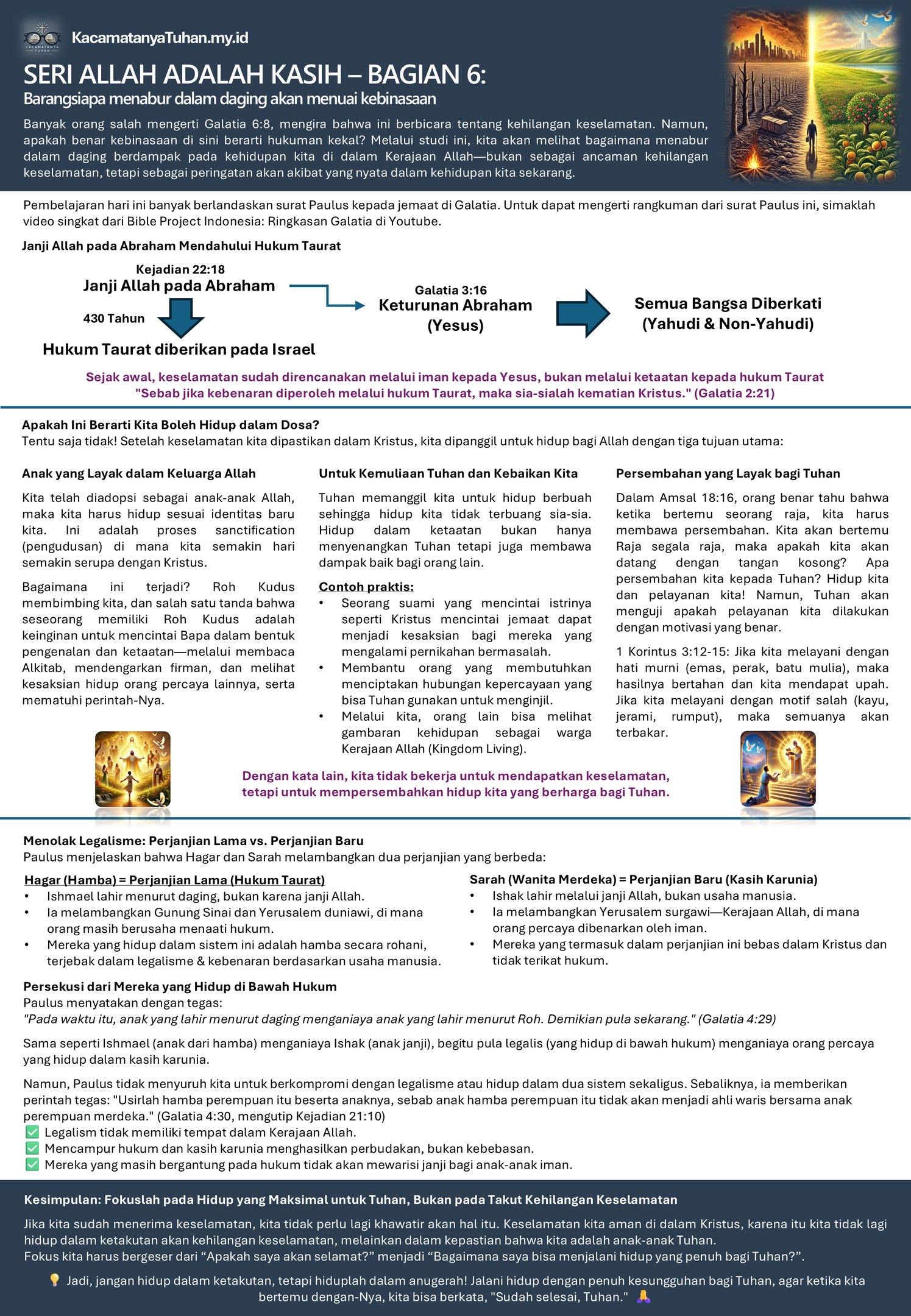
Complete English translation
Whoever sows in the flesh will reap destruction
Many people misunderstand Galatians 6:8, thinking that it speaks of the loss of salvation. However, is it true that destruction here means eternal punishment?
Through this study, we will see how sowing in the flesh impacts our lives in the Kingdom of God—not as a threat of loss of salvation, but as a warning of the real consequences in our lives now.
📺 Before continuing, we invite you to watch "Bible Project Indonesia: Summary of Galatia" on YouTube to get a big picture of Paul's letter to the congregation in Galatia.
God's Promise to Abraham Precedes the Law
Before the law was given to Moses, God first gave a promise to Abraham that through his descendants (Jesus), all nations would be blessed.
"In your descendants all the nations of the earth will be blessed, because you have listened to My words." (Genesis 22:18)
Paul emphasized in Galatians 3:16 that this promise was not given to many descendants, but to one descendant, namely Christ. This means that from the beginning, salvation has been planned through faith in Jesus, not through obedience to the law.
When the law was given to Moses 430 years after the promise to Abraham (Galatians 3:17), the law was not the way of salvation, but only served as a guide to lead people to Christ (Galatians 3:24). Therefore, believers no longer live under the law, but under grace.
"For if the truth is obtained through the law, then the death of Christ is in vain." (Galatians 2:21)
The Gospel is very clear: salvation is only through faith in Jesus, without the addition of the law or human deeds. Mixing the Gospel with the law means belittling the work of Christ's redemption on the cross. Therefore, we are called to live in grace, not in the slavery of the law.
Does This Mean We Can Live in Sin?
Of course not! After our salvation is confirmed in Christ, we are called to live for God with three main purposes:
1. Becoming a Worthy Child in God's Family
We have been adopted as God's children, so we must live according to our new identity. This is the process of sanctification (sanctification) where we are increasingly similar to Christ.
How did this happen? The Holy Spirit guides us, and one of the signs that one has the Holy Spirit is the desire to love the Father in the form of knowledge and obedience—through reading the Bible, listening to the word, and seeing the testimony of other believers' lives, and obeying His commandments.
2. Sanctification is for the Glory of God and Our Goodness
God calls us to live fruitfully so that our lives are not wasted.
Living in obedience not only pleases God but also brings a good impact to others.
Practical example:
A husband who loves his wife like Christ loves the church can be a testimony for those who are experiencing a troubled marriage.
Helping people in need to create a relationship of trust that God can use to introduce the Gospel.
Through us, other people can see the picture of life as a citizen of the Kingdom of God (Kingdom Living).
3. Bringing Worthy Offerings to God
In Proverbs 18:16, the righteous know that when we meet a king, we must bring offerings.
We will meet the King of kings, so will we come empty-handed?
What do we offer to God? Our life and our service! However, God will test whether our ministry is done with the right motivation.
1 Corinthians 3:12-15:
If we serve with a pure heart (gold, silver, precious stones), then the result lasts and we get a reward.
If we serve with the wrong motive (wood, straw, grass), then everything will burn.
In other words, we do not work to get salvation, but to offer our precious lives to God.
Rejecting Legalism: Old Testament vs. New Testament
Paul explained that Hagar and Sarah symbolized two different covenants:
Hagar (Servant) = Old Testament (Law)
Ishmael was born according to the flesh, not because of God's promise.
It symbolizes Mount Sinai and the worldly Jerusalem, where people are still trying to obey the law.
Those who live in this system are spiritual servants, trapped in legalism and truth based on human effort.
Sarah (Free Woman) = New Covenant (Love of Grace)
Isaac was born through God's promise, not human effort.
He symbolizes the heavenly Jerusalem—The Kingdom of God, where believers are justified by faith.
Those who are included in this covenant are free in Christ and not bound by law.
Persecution of Those Who Live Under the Law
Paul stated firmly:
"At that time, the child who was born according to the flesh persecuted the child who was born according to the Spirit. Likewise now." (Galatians 4:29)
✅ Just like Ishmael (son of the servant) persecutes Isaac (son of the promise),
✅ Likewise, legalists (who live under the law) persecute believers who live in grace.
However, Paul does not tell us to compromise with legalism or live in two systems at once. Instead, he gave a firm command:
"Exorct the maidservant and her son, because the son of the maidservant will not be the heir with the free daughter." (Galatians 4:30, quoting Genesis 21:10)
✅ Legalism has no place in the Kingdom of God.
✅ Mixing law and grace produces slavery, not freedom.
✅ Those who still depend on the law will not inherit the promise for the children of faith.
💡 This is why you must separate yourself from the legalistic system—not because you reject God, but because you accept the true gospel, which is grace in Christ.
Conclusion: Focus on Living to the Maximum for God, Not on Fear of Losing Salvation
If we have received salvation, we no longer need to worry about it. Our salvation is safe in Christ, therefore we no longer live in fear of losing salvation, but in the certainty that we are God's children.
Our focus must shift from "Will I survive?" Become "How can I live a full life for God?".
Like Jesus who at the end of His life said:
"It's done." (John 19:30)
We also want to end our lives with full confidence that we have lived a life that is pleasing to God.
💡 So, don't live in fear, but live in grace! Live life with full sincerity for God, so that when we meet Him, we can say, "It's over, God." 🙏