
Complete English translation
### Introduction
Many people think that a true Christian must live without sin, and if he still sins, then his salvation is questioned. However, is this really the meaning of verse 1 John 3:9? Understanding this verse in the light of God's grace will give a clearer perspective.
---
### 1. The Meaning of Verse 1 John 3:9 in Context
This verse says:
> "Everyone who is born of God, does not sin anymore; because the seed of the Divine (Holy Spirit) remains in him and he cannot sin, because he is born of God."
If understood separately, this verse seems to state that a Christian cannot sin again. However, in the same letter, John also stated:
> "If we say that we are not guilty, then we are deceiving ourselves and the truth is not in us. If we confess our sins then He is faithful and just, so that He will forgive all our sins and cleanse us from all evil." (1 John 1:8-9)
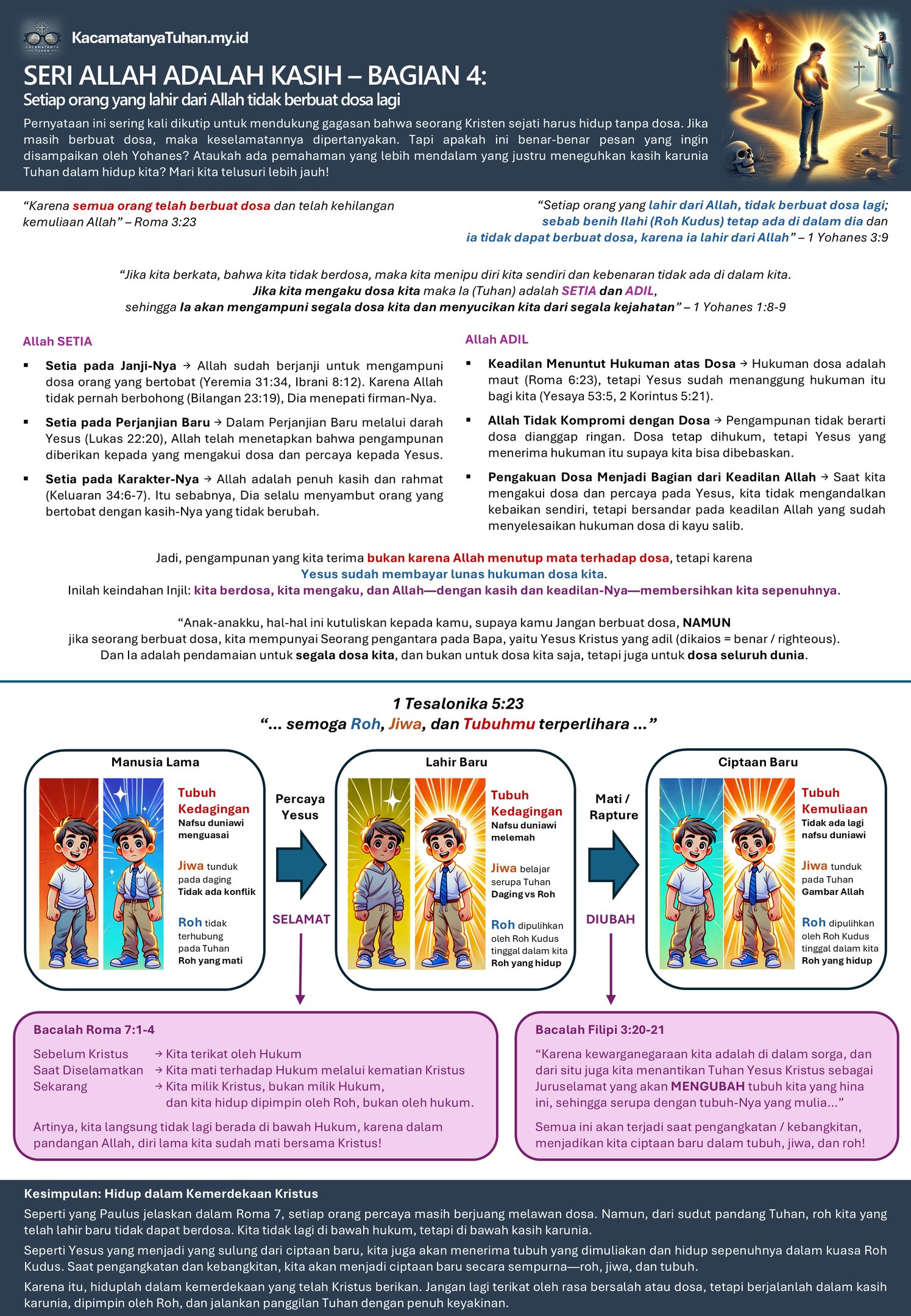
This statement shows that the reality of the believer's life still involves the struggle against sin. What John means in 1 John 3:9 is that a person born of God has a renewed spirit, so that he no longer lives in a pattern of sin as a habit or lifestyle. There is a difference between someone who occasionally falls into sin and those who constantly live in sin without repentance.
Romans 7 describes the struggle between flesh and spirit in a believer. Paul explained that although the body can still fall into sin, the renewed spirit does not submit to sin. This struggle is not a sign of loss of salvation, but proof that a believer has experienced a deep inner change. In the light of Romans 8:1-2, those who are in Christ are not under condemnation because the law of the Spirit has freed them from the law of sin and death.
---
### 2. God's Grace and His Justice
God remains faithful to His promise in forgiving sins for those who repent, as stated in Jeremiah 31:34 and Hebrews 8:12. He never broke his promise, and His forgiveness was given in the new covenant through the blood of Christ (Luke 22:20). This forgiveness does not mean that Allah ignores sin, because in His justice, every sin must be punished. However, the punishment has been borne by Christ (Isaiah 53:5, 2 Corinthians 5:21).
Forgiveness received is not because sin is taken lightly, but because the punishment has been completed through the cross. In 1 John 2:1-2, Christ acts as an intercessor for believers, showing that although they can still fall into sin, forgiveness is always available in the grace of God.
---
### 3. Journey from Pre-Salvation to Breeding
Before accepting Christ, humans lived under the power of sin. At this stage:
- The body is controlled by the flesh and worldly lust.
- The soul submits to the flesh, without conflict with sin.
- The spirit died and was cut off from God.
When someone believes in Christ:
- The Spirit is renewed by the Holy Spirit and begins to live.
- The soul undergoes renewal, although there is still a struggle between flesh and spirit.
- The body is still weak, but no longer has power over the lives of believers.
When the resurrection or rapture occurs:
- The body is glorified and no longer submits to sin or worldly lust.
- The soul submits completely to God, reflecting the image of Allah perfectly.
- The spirit is fully restored and lives in perfect communion with God.
Philippians 3:20-21 confirms that Jesus will change our humble body to be similar to His glorious body. This change is the fulfillment of the promise of perfect safety.
---
### 4. Conclusion: Living in the Independence of Christ
Believers still fight against sin, but in the eyes of God, their renewed spirit cannot live in sin. Living in Christ means being free from condemnation and living under grace, not law.
In the end, the resurrection will bring perfection to believers, making them completely new creations in spirit, soul, and body. Therefore, they are called to live in the freedom that Christ has given, not in guilt or fear of sin, but in the certainty of His salvation and grace.
Romans 8:1-2 affirms that those who are in Christ are not under condemnation. Salvation is not the result of human efforts, but the grace of God that liberates.
### Reflection
- Is there still a fear in yourself of sins that have been forgiven?
- How can we rely more on God's grace in living a life of faith?
- What are the concrete steps to grow in obedience to God?
Living in the freedom of Christ means walking in faith, not in fear. God has liberated, and His call is to live in the light of His love and righteousness.