Complete English translation
Opening: The Difference in the Purpose of Sacrifice in Idol Worship and Sacrifice to God
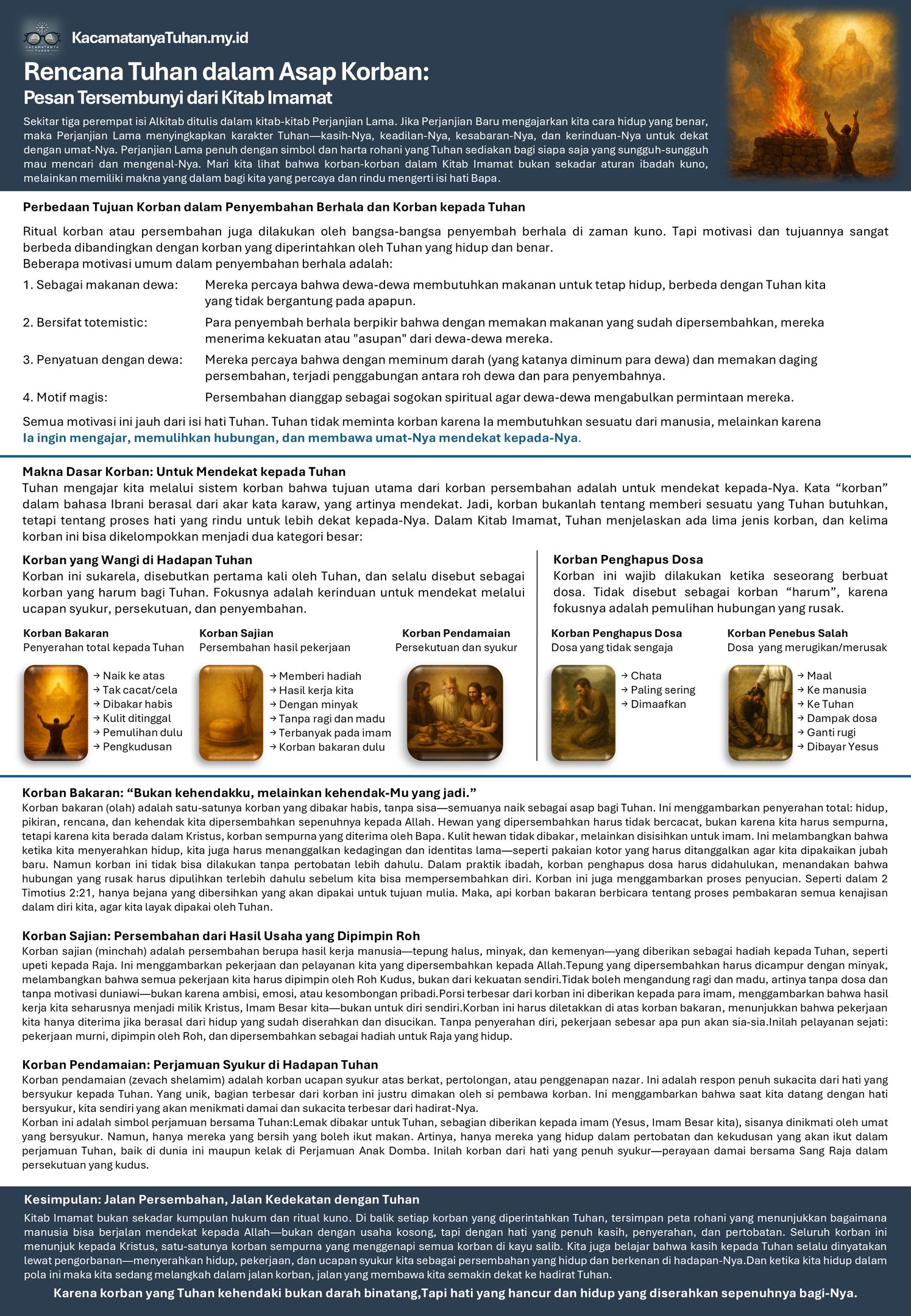
The ritual of sacrifice or offering was also performed by idolatrous nations in ancient times. But the motivation and purpose are very different compared to the victim who was commanded by the living and true God.
Some common motivations in idolatry are:
As food for the gods.
They believe that gods need food to stay alive, unlike our God who does not depend on anything (Psalm 50:12-13).
Totemistic.
The idolaters think that by eating the food that has been offered, they receive power or "intake" from their gods.
Union with God through sacrifice.
They believe that by drinking blood (which is said to be drunk by the gods) and eating the meat offerings, there is a union between the spirits of the gods and their worshippers.
Magical motif.
Offerings are considered spiritual bribes so that the gods grant their wishes.
All these motivations are far from God's heart. God does not ask for sacrifice because He needs something from humans, but because He wants to teach, restore relationships, and bring His people closer to Him.
Now let's take a deeper look at what exactly God conveys and teaches through the sacrifices in the Book of Leviticus.
The Basic Meaning of Sacrifice: To Get Closer to God
God teaches us through the sacrificial system that the main purpose of the sacrifice is to get closer to Him. The word "sacrifice" in Hebrew is victim, which comes from the root word karaw, which means to approach.
So, sacrifice is not about giving something that God needs, but about the process of the heart that longs to be closer to Him.
In the Book of Leviticus, God explains that there are five types of sacrifices, and these five sacrifices can be grouped into two major categories:
Group 1: Fragrant Sacrifice Before God (Voluntary Offerings)
This sacrifice is voluntary, first mentioned by God, and always called a fragrant sacrifice for God.
The focus is the longing to get closer through thanksgiving, fellowship, and worship.
Types of victims:
Burnt Offering (Burnt Offering)
Grain Offering (Grain Offering)
Peace Offering (Peace Offering)
Group 2: Obligatory Offerings
This sacrifice must be done when someone commits a sin.
Not called a "fragrant" victim, because the focus is not on worship, but on the restoration of broken relationships (expiation).
Types of victims:
4. Sin Offering (Sin Offering)
5. Guilt/Trespass Offering (Guilt/Trespass Offering)
Summary of the Five Victims in the Book of Leviticus
1. Burnt Offering – Leviticus 1
Meaning: Total surrender to God.
Symbol: A life that is completely burned to God, without a trace—except for the skin set aside for the priest.
Spiritual message: This talks about the process of sanctification, giving up life to be formed, burned, and completely sanctified by God.
Typology: Christ surrendered himself completely as a blameless sacrifice.
Status: Voluntary, fragrant to God.
2. Sacrifice Offering (Meal Offering) – Leviticus 2
Meaning: Offering from the result of human work, a symbol of gratitude and dedication.
Symbol: Fine flour without yeast or honey—shows purity, without arrogance or worldly emotions.
Spiritual message: Symbolizing our work for God—an offering that will be tested by fire before Him (1 Cor 3:13).
Typology: Jesus' perfect humanity, and His ministry on earth.
Status: Voluntary, fragrant to God.
3. Peace Offering – Leviticus 3
Meaning: Fellowship and thanksgiving for God's blessings.
Symbol: Part of it is burned for God, part of it is for the priest, and the largest portion is enjoyed by the sacrificial bearer in the banquet with God.
Spiritual message: We rejoice in His presence, but only those who live in holiness will participate in the Supper of the Lamb. Lazy servants will not join the party.
Typology: Peace and fellowship that we have through the sacrifice of Christ (Romans 5:1).
Status: Voluntary, fragrant to God.
4. Sin Offering – Leviticus 4:4–5:13
Meaning: Forgiveness of sins committed unintentionally.
Symbol: Blood is splattered in the sanctuary, depending on the status of the person who committed the sin.
Spiritual message: Sin tarnishes and destroys the relationship with God. This victim restored the relationship.
Typology: Christ as the Bearer of Sin, who takes away our sins through His blood.
Status: Mandatory, not fragrant.
5. Trespass Offering – Leviticus 5:14–6:7
Meaning: Forgiveness for sins that cause harm to others or to God.
Symbol: Including return of rights + 20%, before the sacrifice is offered.
Spiritual message: Sin not only violates God's law, but also harms others. Therefore, real repentance and restoration are needed (Mat 5:23-24).
Typology: Christ as our Compensation, which restores our relationship with God and others.
Status: Mandatory, not fragrant.
In this session, we will only focus on the Fragrant Victim in front of Allah:
Burnt Offering: Total Surrender to God
The burnt offering (olah, from the Hebrew word which means "up") is the only sacrifice in the Book of Leviticus that is burned entirely for God. No part of this animal is eaten or shared. All "rise" upwards as the smoke of an offering—indicating that this sacrifice is dedicated entirely to God the Father.
1. Entirely for God: Ascending
The word itself describes the direction: up.
This sacrifice is not for humans, not for priests—only for God. This is a pure form of worship, with no other motive other than saying:
“I am yours completely, Lord.”
As Jesus said in the garden of Getssemane:
"It's not My will, but Your will that happens."
2. Imperfect: Being in the Perfect Christ
God commanded that the animal that was offered must be male and without blemish (Leviticus 1:3).
This does not mean that we must be morally perfect to come to God. On the contrary, this sacrifice symbolizes Jesus, the immacable Lamb—and we are accepted because we are in Him (Ephesians 1:6, 2 Corinthians 5:21).
It means, our surrender becomes pleasing to God not because we are good, but because we are in a perfect Victim.
3. Burned Completely: Giving Up Your Whole Life
Every part of the victim was burned—head, stomach, legs, everything. This symbolizes total surrender:
Head → Our thoughts and will
Fill in the stomach → Fill our hearts and emotions
Feet → Steps and direction of our life
Nothing is saved. Everything was placed on the altar. This is the true picture of a sanctified life—where God is not only the Savior, but also the Lord of everything.
4. Unburned Skin: Leaving Dirty Flesh and Clothes
The only part that is not burned is the skin (Leviticus 7:8). This skin was given to the priest.
This holds a deep spiritual meaning:
The skin symbolizes the physical body or worldly identity—which we must leave.
Like the dirty clothes in Zechariah 3:4, we need to be released from our old identity, from sin and the desires of the flesh, so that we can wear a new robe of righteousness.
As Paul said: "Throw away the old man..." (Ephesians 4:22)
5. Must be preceded by the victim of the forgiveness of sins
In the practice of worship in the Holy Tent and the Temple of God, burnt offerings should not be done before the sin offering is offered.
It means spiritually:
A broken relationship with God must be restored first before we can offer our lives.
We cannot worship properly if sin is still an obstacle (Isaiah 59:2). Therefore, confession and repentance become the entrance to true worship.
6. Related to the Purification and Purification of Vessels
2 Timothy 2:20–21 teaches that in the big house there are vessels of gold, silver, wood, and clay.
Only vessels that are sanctified and cleaned of impurity will be used for noble purposes by the King.
The victim of the burning talks about the process:
We are vessels.
The fire on the altar depicts the fire of purification.
When we are willing to be burned, God erases our flesh, cleanses us from pride, personal ambition, and iniquity (evil inclination).
After that, we are ready to be used in God's great plan.
Conclusion
The burnt sacrifice is the image of the life of a believer who surrenders everything to God—not partially, but completely.
Not because we are holy, but because we believe in the Perfect Victim—Jesus Christ.
This sacrifice teaches us that love for God is not enough with words. True love is always proven through surrender, like Jesus, who said:
"I have come to do Your will, oh my God." (Ibranians 10:7)
Serving Sacrifice: Offering the Proceeds of the Business for the Glory of the King
If the burnt sacrifice describes the total surrender of life, then the burnt sacrifice is about what we produce from the life that has been given. In Hebrew it is called minchah, this sacrifice is not in the form of blood, but the result of the harvest and human work—fine flour, oil, and incense. This is a gift to God, like an offering of tribute to the King.
In the ancient world, bringing tribute to the king was the highest form of respect. But here, the Most High God—who does not need anything from man—opens up an opportunity for us to bring the work of our hands, and present it as something pleasing. That is the offering sacrifice: the result of work given with humility, in holiness, and with the guidance of the Holy Spirit.
1. This Is Our Work, But Offered as a Gift to God
Refined flour is not a raw material from the field. This is a harvest that has been processed—ground, sifted, and purified. This is effort and hard work, and it symbolizes how we serve God through daily life, our work, our ministry, even our handwork.
But what God values is not how much or how great the result is—what God sees is how we present it. Is it done for Him? Does it come from a clean heart?
2. Must be Mixed with Oil: Work Led by the Holy Spirit
God ordered the flour to be mixed with oil (Leviticus 2:1). Oil always symbolizes the Holy Spirit in the Bible.
Meaning: our work must be led and strengthened by the Spirit, not from our own strength.
As said in Zechariah 4:6:
"Not by strength, not by might, but by My Spirit."
Without oil, our offering will be dry and unpleasing. But with oil, even small businesses become fragrant in front of God.
3. Without yeast and Honey: The Purity of the Motif
Offerings must not contain yeast and honey (Leviticus 2:11).
Lest symbolizes sin, pride, hypocrisy.
Honey symbolizes worldly pleasure or emotional motivation that is sweet in the mouth but rotten inside.
That is, the work we do for God must not come from the desires of the flesh—such as seeking recognition, status, or personal reward.
God rejects a ministry that looks spiritual on the outside, but is carried out with the wrong motive on the inside.
4. Majority Given to the Priest: Offering for Our Imam King
The victims of the service were not completely burned. A small part was burned as a "God's" part with incense, but a large part was given to the priests (Leviticus 2:3).
In the New Testament, we know that our High Priest is Jesus Christ (Hebrews 4:14).
It means, the result of our work, our service, all in the end is for Him. He is the one who deserves the best part of our lives, because He is our King and Great Priest.
5. Placed on the Burnt Victim: Work that Follows Surrender
Leviticus 3:5 shows that the offering must be placed on top of the burnt offering. This is very important spiritually.
Before we can present our work, we must first present ourselves.
Work that does not come out of life that is handed over will lead to arrogance or futility. But if the work flows from a life that has been burned and sanctified, then the work will become a fragrant smell that pleases God.
Conclusion: Pure Work Offering and Offered to the King
The sacrifice teaches that true service begins with a clean heart and a surrendered life.
God invites us to offer our work—which is processed, purified, and led by the Holy Spirit—as a tribute to Him.
But don't forget: God does not judge the greatness of the result, but the purity of his heart.
Do we work out of love for Him?
Do we serve to please our King, not to be praised by humans?
And when we offer it all in holiness, then our offering becomes minchah—a gift that pleases God.
Atoning Sacrifice: Thanksgiving With God
Among the five sacrifices in the Book of Leviticus, the sacrifice of atonement (zevach shelamim) is the most loaded with joy and fellowship. Unlike the sin offering that is full of confession, or a burnt offering that is burned out for God, this sacrifice is an invitation to sit and eat with God. The atmosphere is not full of tension or guilt, but a party atmosphere—full of peace, gratitude, and familiarity.
1. The Motivation: Thanksgiving and Celebration for God's Help
The sacrifice of atonement is not because someone commits a sin, but because he wants to give thanks to God—either because of the blessings received, the prayers that are answered, the vows that are fulfilled, or simply because of a heart full of joy over the goodness of God.
In Leviticus 7, there are three types of peace offerings:
Thanksgiving sacrifice
Victim because of vows
Voluntary victim
All of these types speak of personal response to God's goodness—that after seeing His help, a person is not just silent, but comes with a sacrifice and invites God to "celebrate" together.
2. The One Who Eats Is The One Who Carries The Victim
This is the unique thing: of all the victims, this victim is the only one where the bearer of the victim gets the biggest share.
Fat is burned for God
Chest and thighs are given to the priest
The rest of the meat was eaten by the carrier and his family
This shows one beautiful thing:
When we come to thank God, we ourselves will receive the greatest joy from His presence.
This illustrates that peace, joy, and spiritual satisfaction do not belong to God alone—but the blessings that God deliberately bestows on us as we live in a true relationship with Him.
3. Symbol of Holy Communion: Eating with God
This sacrifice is the spiritual image of the table of communion—we eat with God.
Some rise as an aroma for Father
Part of it is given to the High Priest (symbol of Christ)
The rest is enjoyed by His grateful people
This is a spiritual feast, the forerunner of the Lamb's Supper (Revelation 19:9).
When we eat from this sacrifice, it is like we are sitting with God the Father, Jesus Christ as our High Priest, and fellow believers in holy fellowship.
4. Everything You Eat Must Be Clean
However, not everyone can eat. The condition is one: it must be clean ritually.
Leviticus 7:20-21 confirms that anyone who is unclean and continues to eat, will be separated from God's people.
This illustrates that:
Peace with God must be accompanied by holiness.
Not everyone will participate in the Lord's banquet, even if they are invited.
This is in line with Jesus' parable about the feast of the feast, where there is a man who enters without the clothes of the feast—and finally goes out (Matthew 22:11-13).
Conclusion: True Joy Exists in Holy Fellowship
The sacrifice of atonement shows that God wants us to not only believe in Him, but also to rejoice with Him.
When we come in gratitude, we ourselves will receive the greatest part of the banquet—peace, joy, irreplaceable inner satisfaction.
But this banquet is only for those who have been sanctified, who live in repentance, surrender, and sincere service.
For the lazy servant, who is not ready, who is not clean, the door of the party will be closed.
But for those who live in holiness and gratitude, God says:
"Come, sit with Me and enjoy the banquet of peace."
Conclusion: The Path of Worship, the Path of Closeness to God
The Book of Leviticus is not just a collection of ancient laws and rituals. Behind every sacrifice that God commands, there is a spiritual map that shows how humans can walk closer to God—not with empty efforts, but with a heart full of love, submission, and repentance.
These five sacrifices form a complete spiritual journey:
Burnt Offering - Surrendering life completely to God: "Not my will, but Your will."
Sacrifice - Presenting the results of our work, led by the Holy Spirit, and purely from worldly motivation.
Atonement Sacrifice - Celebrating peace and joy in fellowship with God, living in holy thanksgiving.
Sacrifice of Sin - Restoring a broken relationship because of sin that defiled us before Him.
False Redeemer Victim - Shows that true repentance also restores the damage caused to others, not just to God.
This whole sacrifice points to Christ, the only perfect sacrifice who fulfilled all sacrifices on the cross. But through these symbols, we also learn that love for God is always expressed through sacrifice—giving our lives, work, and thanksgiving as a living and pleasing offering before Him.
And when we live in this pattern—surrender, service, gratitude, repentance, and restoration—then we are stepping on the path of sacrifice, the path that brings us closer to the presence of God.
Because the sacrifice that God wants is not animal blood,
But a broken heart and a life that is completely surrendered to Him.