
Complete English translation
Introduction
Many Christians today believe that the Church is a "spiritual Israel." They interpret that after Jesus came, God's people changed from the nation of Israel to the Church, so that all of God's promises to Israel now apply directly to the Church. But is this understanding really in accordance with the Bible?
In this article, we will study calmly and carefully about three important terms in God's plan of salvation:
Physical Israel (Israel outwardly),
Spiritual Israel (the rest of the Israelites who truly believed), and
Church (people from all nations who believe in Christ).
We will see that the Bible has never equated the Church with Israel. Although both are equally important in God's plan, their identities and roles are different. Through the explanation of the olive tree in Romans 11, we will also see how other nations can enter into God's blessing without replacing Israel.
The purpose of this article is to help us understand the difference between Israel and the Church, and how both are included in one great plan of God that is fulfilled in Jesus Christ. With the right understanding, we can appreciate God's faithful love for His people throughout history—and live our calling as part of the body of Christ more clearly.
I. Definition of Three Entities: Physical Israel, Spiritual Israel, and Church
To understand the relationship between Israel and the Church, we must first realize that the word "Israel" itself has several layers of meaning in the Bible. This term does not only point to one thing, but develops gradually as God's plan is revealed in history.
Here are the four main dimensions of the meaning of "Israel" according to the Bible:
1. Israel as a Person - Jacob whose Name Was Changed
God first used the name "Israel" as a new name for Jacob, Abraham's grandson. This name was given after Jacob struggled with God and came out as a winner.
"Your name will not be called Jacob anymore, but Israel, because you have struggled with God and man, and you have won."
– Genesis 32:28
2. Israel as Descendants - Twelve Tribes of Israel
The children of Jacob became twelve tribes known as Israel, and from here came the identity of the tribe and nationality that began to form.
"These are all the tribes of Israel, twelve of them, and this is what their father said to them when he blessed them."
– Genesis 49:28
3. Israel as a Nation – God's Chosen People
When they came out of Egypt, God called Israel His firstborn, emphasizing that this nation had a special status in front of Him.
"Thus says the LORD: Israel is My son, My firstborn."
– Exodus 4:22
4. Israel as a Loyal Rest – Remnant
However, not all of the Israelites were loyal to God. Throughout history, only a small part has truly believed and obeyed. They are the ones who are called "remainings", or often referred to as spiritual Israel.
"Even if the number of the children of Israel is like the sand in the sea, only the rest will return."
– Isaiah 10:22
"Because not everyone who comes from Israel is Israel."
- Romans 9:6
By understanding that the word "Israel" can refer to individuals, tribes, nations, and the rest of the believers, we will be more prepared to clearly distinguish what the Church is, and how its role differs from Israel in God's plan of salvation.
To understand the difference between Israel and the Church, we first need to recognize three important terms that often appear in Bible readings: physical Israel, spiritual Israel, and Church. These three terms have different meanings and roles in Allah's plan, although often people think they are all the same thing.
1. Physical Israel
Physical Israel is God's chosen nation that comes from the descendants of Jacob (who was later named Israel by God). They consisted of twelve tribes, and God gave them promises about land, descendants, and kingdom through Abraham, Isaac, and Jacob.
Verse example:
"Your name will no longer be called Jacob, but Israel..." – Genesis 32:28
"...The Israelites to whom have been given adoption as children, glory, covenant, law..." – Romans 9:4
Characteristics:
Physical descent from Jacob
Recipients of the law and old covenants
Have a clear national identity and history
Not everyone believes in the Messiah
2. Spiritual Israel
Spiritual Israel refers to the rest of the Jews who believe in God and are faithful to His covenant. They were the Israelites who were not only of physical descent, but also had true faith in God—and in the age of the new covenant, to Jesus as the Messiah.
Verse example:
“For not all who are of Israel are Israel.” – Romans 9:6
"So also at this time there is a remnant, according to the choice of grace." – Romans 11:5
Characteristics:
Still from the nation of Israel
Believe and live faithfully to Allah
Included in salvation because of faith
Part of the Church, but still called the rest of Israel
3. Church
The church is the body of Christ, consisting of people from all nations—both Jews and non-Jews—who believe in Jesus and are saved by grace through faith. The church is not the result of physical descent, but born from a spiritual new birth.
Verse example:
"For in one Spirit we all, both Jews and Greeks... have been baptized into one body." – 1 Corinthians 12:13
"For you are all children of God through faith in Christ Jesus." – Galatian 3:26
Characteristics:
Open to anyone who believes in Jesus
Not formed based on lineage
Called the body of Christ, not Israel
Called to preach the Gospel to the whole world
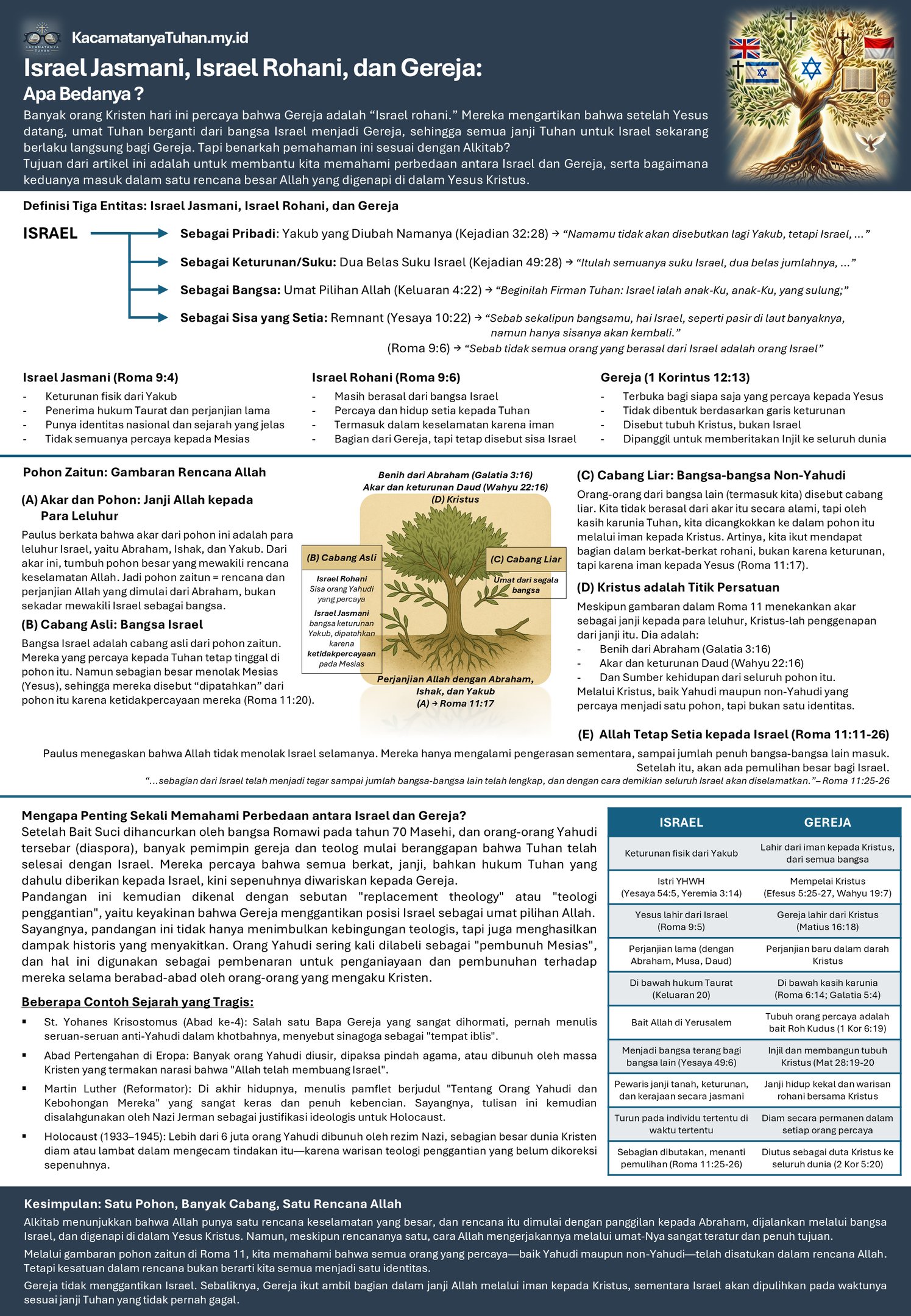
II. Olive Tree - Overview of God's Plan
To explain the relationship between Israel and the Church, Apostle Paul used the image of the olive tree in Romans 11. This description is very important because it shows how non-Jewish nations can be included in God's plan of salvation without replacing Israel.
A. Roots and Trees: God's Promise to the Ancestors
Paul said that the roots of this tree are the ancestors of Israel, namely Abraham, Isaac, and Jacob. From this root, grows a big tree that represents God's plan of salvation.
"...You, like a wild olive branch, have been grafted between the other branches and also got a part in the root of the olive tree that is rich in sap."
– Romans 11:17
So the olive tree = God's plan and covenant that started from Abraham, not just representing Israel as a nation.
B. Original Branch: Israelites
The Israelites are the original branch of the olive tree. Those who believe in God stay on that tree. But most rejected the Messiah (Jesus), so they were called "broken" from the tree because of their unbelief (Romans 11:20).
"Some branches have been broken down because of their unbelief..." – Romans 11:20
C. Wild Branch: Non-Jewish Nations
People from other nations (including us) are called wild branches. We do not come from that root naturally, but by God's grace, we are grafted into that tree through faith in Christ.
"...You were grafted and also got a share..." – Romans 11:17
It means, we get a part in spiritual blessings, not because of descent, but because of faith in Jesus.
D. Christ is the Point of Unity
Although the picture in Romans 11 emphasizes the root as a promise to the ancestors, Christ is the fulfillment of that promise. He is:
Seed from Abraham (Galatians 3:16),
The roots and descendants of David (Revelation 22:16),
And the source of life from the whole tree.
Through Christ, both Jews and non-Jews who believe become one tree, but not one identity.
E. God Remains Faithful to Israel
Paul asserted that God had not rejected Israel forever. They only experienced temporary hardening, until the full number of other nations entered. After that, there will be a big recovery for Israel.
"...Part of Israel has become strong until the number of other nations is complete, and in that way all of Israel will be saved."
– Romans 11:25-26
Conclusion
The olive tree is not a symbol of Israel alone, but a symbol of God's plan of salvation that flows from His promise to Abraham and is fulfilled in Christ.
Israel is the original branch,
Other nations are wild branches,
And all who believe in Christ have a share in the life of the tree—without replacing its original branches.
Why is it important to understand the difference between Israel and the Church?
After the Temple was destroyed by the Romans in 70 AD, and the Jews dispersed (diaspora), many church leaders and theologians began to assume that God was finished with Israel. They believe that all blessings, promises, even God's laws that were once given to Israel, are now fully inherited to the Church.
This view is later known as "replacement theology" or "replacement theology", which is the belief that the Church replaces Israel's position as God's chosen people.
Unfortunately, this view not only causes theological confusion, but also produces a painful historical impact. Jews are often labeled as "killers of the Messiah", and this is used as a justification for the persecution and murder of them over the centuries by people who claim to be Christians.
Some Examples of Tragic History:
St. John Chrysostom (4th century): One of the highly respected Church Fathers, once wrote anti-Jewish calls in his sermons, calling the synagogue "the place of the devil".
Medieval in Europe: Many Jews were expelled, forced to convert, or killed by the Christian masses who were consumed by the narrative that "God has thrown away Israel".
Martin Luther (Reformator): At the end of his life, he wrote a pamphlet entitled "About the Jews and Their Lies" which was very harsh and hateful. Unfortunately, this writing was later misused by Nazi Germany as an ideological justification for the Holocaust.
The Holocaust (1933–1945): More than 6 million Jews were killed by the Nazi regime, most of the Christian world is silent or slow to condemn the act—because of its legacy of replacement theology that has not been fully corrected.
Why Is This Relevant Today?
Considering the Church as "spiritual Israel" without distinguishing the clear context and identity in the Bible, can open the door to:
Spiritual pride towards the Jewish people,
Rejection of God's unfulfilled promise to Israel,
And finally, twisting the image of God who is faithful to His covenant.
On the contrary, understanding that Israel and the Church are two different entities but both loved by God, will lead us to:
Respect for God's covenant people,
Humility as other nations grafted into the olive tree,
And the true understanding of Allah's loyalty to His promise.
When theology is not properly maintained, it not only affects thought—but can have an impact on the history of mankind.
The difference between Israel and the Church
After understanding that Israel and the Church are two different entities in God's plan, it is important for us to see what are the fundamental differences between the two. Although both are called by God and blessed by His grace, they have different identities, origins, and roles in the history of salvation.
Often, people think that the Church replaces Israel, because both are called God's people. But if we look closely, the Bible shows that God has a unique plan for Israel and his own plan for the Church, and the two go side by side, not replace each other.
Here is a comparison to clarify:
Comparison: Israel vs. Church (see picture above)
Important Emphany
The Church has not replaced Israel, and Israel has not been canceled. God is faithful to all His promises, both to Israel and to the Church.
Both have a part in the same tree (Allah's plan), but each still has a different identity.
Conclusion: One Tree, Many Branches, One God's Plan
From beginning to end, the Bible shows that God had a great plan of salvation, and that plan began with a call to Abraham, carried out through the people of Israel, and fulfilled in Jesus Christ. However, even though the plan is one, the way Allah does it through His people is very organized and full of purpose.
We have learned that:
Physical Israel is God's chosen nation physically.
Spiritual Israel is the rest of the Israelites who believe and are faithful.
The Church is the body of Christ, which consists of people from all nations who believe in Him.
Through the description of the olive tree in Romans 11, we understand that all believers—both Jews and non-Jews—have been united in God's plan. But unity in the plan does not mean that we are all one identity.
Branches are still branches—some are real, some are wild, but they are all connected to the same tree because of God's grace.
The church does not replace Israel. On the contrary, the Church takes part in God's promise through faith in Christ, while Israel will be restored in time according to God's promise that never fails.
As believers, this understanding teaches us to:
Be humble, because we are grafted not because we deserve it, but because of grace.
Appreciate Israel, because God still has an unfinished promise for them.
Grateful, because all of us—both Jews and non-Jews—have been given the same opportunity to be God's children through Jesus Christ.
One tree, many branches, one plan of God—with one name that unites everything: Jesus, the Messiah.