Many people think of church as a place to worship, hear God’s Word, pray, and receive spiritual care. All of those things are good and important. But have we ever asked: Is that all Christ formed His Church to do?
If the purpose of salvation were simply to take people to heaven, why did God create humanity in the first place to live and exercise dominion on earth?
To answer that, let’s return to God’s design before humanity fell into sin.
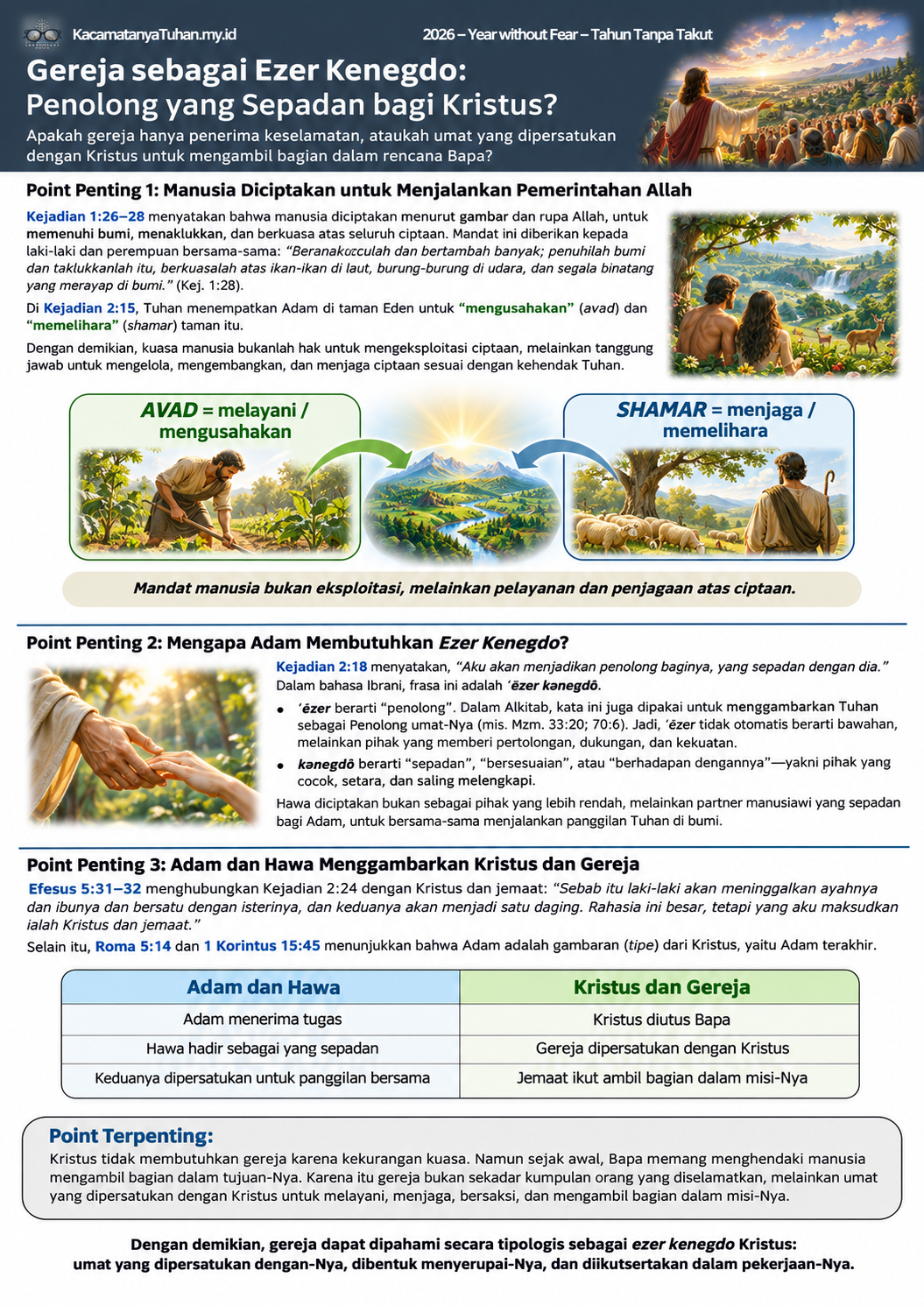
Key Point 1: Humanity Was Created to Exercise God’s Rule
Genesis 1:26–28
God created human beings in His image and likeness and gave them a mandate to be fruitful, multiply, fill the earth, subdue it, and exercise dominion over creation.
Notice that this mandate was given to man and woman together.
From the beginning, people were created not merely to enjoy God’s blessings, but to represent His rule on earth.
In Genesis 2:15, God placed Adam in the garden of Eden to cultivate it and care for it.
The Hebrew uses two important words:
ʿAvad (עָבַד): to work, serve, or cultivate.
Shamar (שָׁמַר): to keep, guard, or protect.
Both words are also used in connection with the Levites’ service and care for the sanctuary (Numbers 3:7–8).
That connection supports the understanding that Adam’s responsibility had a priestly dimension.
The authority God entrusted to humanity, then, was not a license to exploit creation. It was a responsibility to care for it and guard it according to the Creator’s will.
Key Point 2: Why Did Adam Need an Ezer Kenegdo?
Genesis 2:18
“It is not good for the man to be alone. I will make a helper for him who corresponds to him.”
The Hebrew expression translated “a helper who corresponds to him” is ʿēzer kənegdô (עֵזֶר כְּנֶגְדּוֹ).
The word ʿēzer means help or helper. The same word is also used of God as the helper of His people (Psalm 33:20).
So the word helper does not in itself imply a subordinate.
Meanwhile, kənegdô describes someone or something that stands opposite, corresponds to, or matches him.
In the Septuagint, Genesis 2:20 uses the Greek expression boēthos homoios autō, meaning “a helper like him.”
Eve was not created as a servant beneath Adam, but as a human being corresponding to him, to share in the same calling.
Adam first received his task in the garden. Then God brought Eve to him. That order does not diminish their dignity or erase their shared calling.
Genesis 2:24 goes on to say that the two become one flesh.
Here are two distinct people, united in life and purpose.
Key Point 3: Adam and Eve Point to Christ and the Church
Now consider what Paul writes in Ephesians 5:31–32.
Paul quotes Genesis 2:24 about a man and woman becoming one flesh, then says that this great mystery speaks of Christ and the Church.
Seen in light of the New Testament, the relationship between Adam and Eve carries a wider meaning.
Romans 5:14 calls Adam a type of the One to come. In 1 Corinthians 15:45, Christ is called the last Adam.
Notice the parallels:
Adam and Eve
Christ and the Church
Adam receives a task from God
Christ is sent by the Father
Eve is made as a helper corresponding to Adam
The Church is united to Christ
The two become one flesh
Christ and the Church become one body
The two share the creation mandate
The Church is sent to participate in Christ’s mission
But there is an important difference.
Adam needed help because he was limited as a human being. Christ does not need the Church because He lacks power or ability.
Christ has completed His work of redemption (John 19:30).
Yet from the beginning the Father desired for humanity to take part in His purpose for creation. Christ came not only to save people from sin, but also to bring them toward the fulfillment of their calling.
Hebrews 2:14–17 explains that Christ shared in our humanity. Romans 8:29 says that we are being conformed to the image of His Son.
Christ became like us in His humanity so that, through redemption, we might be formed into His likeness.
This is the basis for understanding the Church typologically as Christ’s ezer kenegdo: a people united to Him, formed into His likeness, and brought into His mission.
Scripture does not directly give the Church this title, but the image helps us understand the Church’s relationship and calling in light of the whole of Scripture.
The Most Important Point: Why Does Christ Unite the Church to Himself?
In John 17:22, Jesus says that He has given His disciples the glory the Father gave Him, so that they may be one.
In John 20:21, Jesus says:
“As the Father sent Me, so now I send you.”
And 1 Peter 2:9 calls believers a royal priesthood.
The Church, then, is not simply a gathering of people who have received salvation.
The Church is a people called to serve God, reflect His character, bear witness to Him, pray for the world, and share in Christ’s reign.
We are not completing an unfinished redemption. We participate in the Father’s purpose through the redemption Christ has already completed.
Part 2: What Does This Mean for the Church?
If the Church truly understands herself as Christ's ezer kenegdo, what would change on Monday morning—not just during Sunday worship?
If this interpretation is correct, the Church is not primarily a place where people come to receive ministry.
The Church is a people united to Christ, formed into His likeness, and commissioned to participate in the Father's purpose for the world.
That should change almost everything about how we organize church life.
What should the Church actually look like?
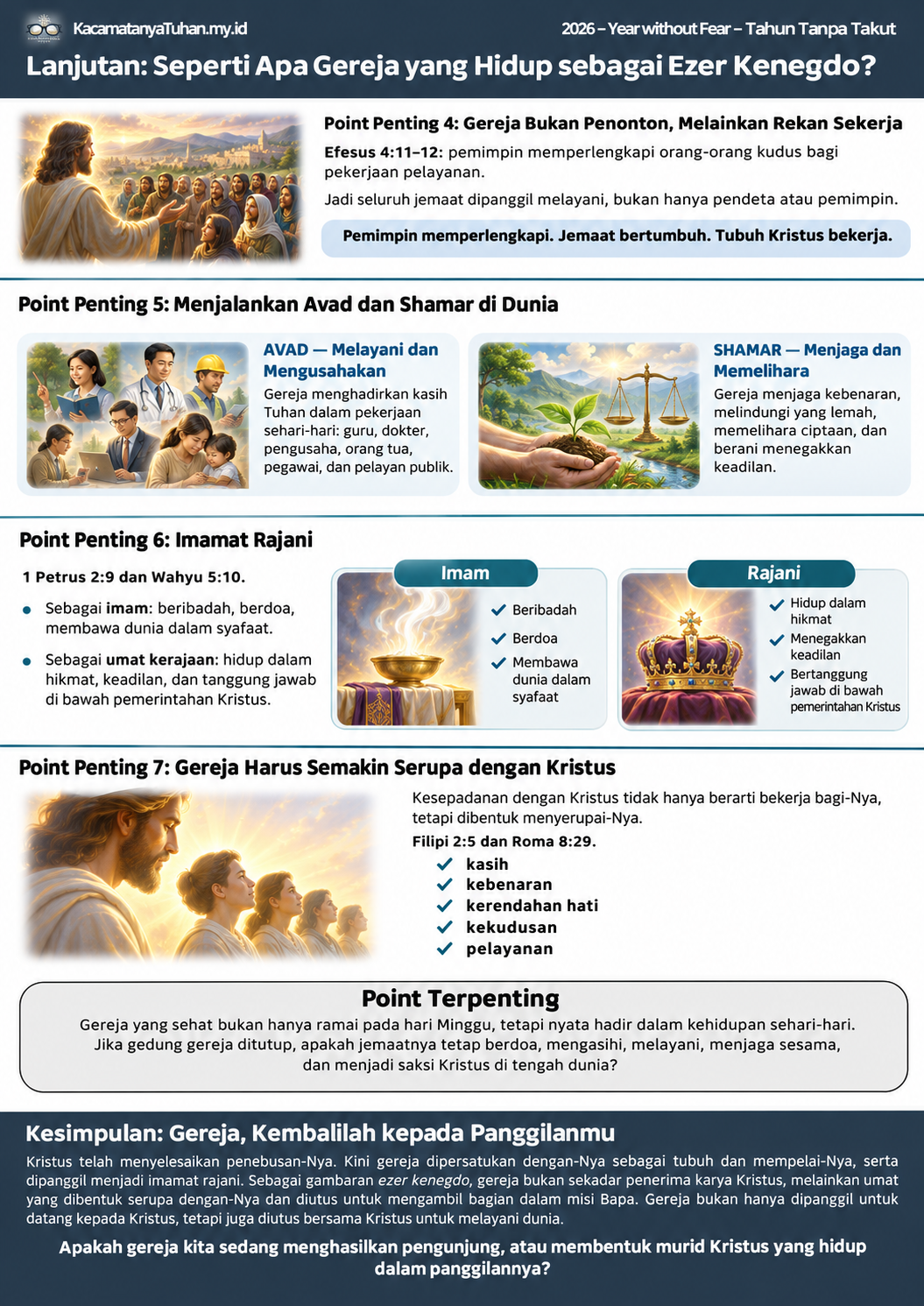
1. A Church of participants, not spectators
Ephesians 4:11–12 tells us that Christ gives ministry leaders to equip His people for works of service.
Notice who is supposed to perform the ministry.
Not just the pastor.
Not just the elders.
The people of God.
A church living as ezer kenegdo would look different:
Conventional church tendency
Church living its calling
Pastor performs ministry
Pastor equips the congregation
Members attend programs
Members participate in God's mission
Success measured by attendance
Success also measured by transformed lives
Ministry happens mainly in church
Ministry happens wherever believers live
Members depend on leaders
Members mature in Christ and serve others
This does not mean eliminating pastors, worship services, or church buildings.
It means recognizing that those structures exist to prepare God's people for their calling.
A Sunday gathering should not be the destination of Christian life. It should also equip people for the week ahead.
2. A Church that practices avad — serving the world
In Genesis 2:15, Adam is placed in Eden to work and serve.
If we understand the Church as participating in Christ's mission, then service cannot be confined to religious activities.
Imagine what this means in reality.
A Christian teacher serves God by educating children with patience, truth, and love.
A Christian business owner serves God by treating employees fairly, creating meaningful work, and refusing corruption.
A Christian doctor serves God by caring for the sick.
A Christian public official serves God by pursuing justice and protecting the vulnerable.
A Christian parent serves God by raising children in wisdom and love.
These are not inferior activities compared with preaching.
They are ways believers can express their calling in the world.
The Church should teach believers to recognize their daily work as a place of Christian vocation.
This is not to say every occupation automatically fulfills God's purposes. The work itself must be examined in light of Christ's character and commands.
3. A Church that practices shamar — guarding what God entrusts
Shamar means to keep, guard, watch over, or preserve.
In the Church's mission, this suggests responsibilities that extend beyond defending correct doctrine.
What should Christians guard?
Truth: Preserve the apostolic gospel and resist deception (2 Timothy 1:14).
People: Protect children, vulnerable members, and those exposed to exploitation (James 1:27).
Justice: Oppose oppression and defend those who cannot defend themselves (Isaiah 1:17).
Creation: Practice responsible stewardship of what God has made (Genesis 2:15).
Community: Protect relationships through truthfulness, reconciliation, and accountability (Ephesians 4:25–32).
These are applications of the wider biblical witness, not five explicit definitions of shamar in Genesis.
Consider a practical example.
If a church discovers that one of its leaders is abusing a congregation member, what should it do?
A church focused primarily on institutional reputation might be tempted to conceal the problem.
A church committed to guarding God's people should protect the victim, ensure independent accountability, and involve civil authorities where appropriate.
Guarding God's people must take precedence over guarding an institution's reputation.
That is a concrete expression of the Church's vocation.
4. A Church that understands royal priesthood
This may be the greatest transformation.
1 Peter 2:9 calls the people of God a royal priesthood.
This calling has two aspects.
Royal
Exercise delegated responsibility through justice, wisdom, stewardship, and service
Priestly
Worship, intercede, proclaim God's goodness, and serve as witnesses of reconciliation
What would that look like?
A congregation prays not only for its own members' prosperity but also for its city, its government, its neighbors, and even its enemies.
It actively works for the good of its community.
Its members exercise responsibility wherever God has placed them.
And its leaders understand that their task is to cultivate the priestly maturity of the entire congregation.
Royal priesthood is not a license for Christians to dominate society. Christ explicitly rejects the pattern of rulers who lord authority over others (Mark 10:42–45).
To reign with Christ is to learn to exercise authority in the manner of Christ.
5. A Church that corresponds to Christ's character
This is where kenegdo becomes especially important.
In this reading, the Church corresponds to Christ through His incarnation and the transformation of His people into His likeness.
Hebrews 2:17 tells us that Christ became like His brothers and sisters.
Romans 8:29 tells us that believers are being conformed to the image of the Son.
Therefore, corresponding to Christ cannot merely mean working for Him.
It also means becoming like Him.
A church cannot claim to participate in Christ's mission while contradicting His character.
Consider these contrasts.
Christ's character
What the Church should demonstrate
He serves rather than dominates
Leadership marked by service
He speaks truth
Honesty and integrity
He welcomes the vulnerable
Compassion and protection
He confronts hypocrisy
Accountability and repentance
He loves His enemies
Reconciliation and peacemaking
He gives Himself for others
Sacrificial generosity
This is not simply a matter of individual morality.
It concerns the character of the Church as a community.
A congregation may have excellent preaching, impressive buildings, and substantial financial resources.
But if its culture is dominated by fear, manipulation, rivalry, or exploitation, it is failing to reflect the character of the One to whom it belongs.
Correspondence requires resemblance, not merely association.
6. A Church where leadership produces maturity rather than dependency
This is particularly important.
Jesus tells His disciples in Matthew 20:25–28 that greatness among them must be expressed through service.
Paul describes the goal of ministry in Ephesians 4:13 as attaining maturity in Christ.
So the purpose of leadership is not to make believers permanently dependent on leaders.
It is to help them grow.
A healthy church should produce people who can study Scripture responsibly, pray, discern truth, exercise their gifts, serve their neighbors, and make wise decisions before God.
This does not eliminate the need for teachers or spiritual guidance.
But it changes the relationship.
The pastor is not a substitute mediator between God and the congregation.
Christ is the mediator.
The pastor is a servant entrusted with helping the congregation mature.
A useful test would be:
After ten years in a church, are its members more capable of living faithfully before God, or more dependent on a particular leader to tell them what God wants?
That question could reveal a great deal about a congregation's spiritual culture.
7. A Church that measures fruit, not merely activity
If the Church's calling is to participate in the Father's purpose, then we must reconsider what success means.
Attendance, financial stability, and organized ministries are useful information.
But they do not tell us whether the congregation is becoming Christlike or fulfilling its calling.
Consider these six dimensions of church life.
A practical Church Calling Scorecard
Illustrative questions for congregational self-assessment—not a biblical scoring formula.
Dimensions assessed 0 / 6
The purpose of this exercise is not to rank churches or reduce spiritual maturity to numbers. It is to encourage honest reflection and meaningful action.
8. What would Sunday worship look like?
There is no need to remove preaching, singing, prayer, communion, or fellowship.
These are central aspects of Christian life.
But it is worth reconsidering what they are intended to produce.
Imagine a Sunday service where the sermon explains Scripture faithfully, then connects that teaching to how members will serve God in their families, workplaces, neighborhoods, and communities.
Imagine congregational prayer that includes the suffering of the city, not only the needs of church members.
Imagine testimonies celebrating reconciliation, integrity, generosity, and service—not only personal financial blessings.
Imagine small groups that equip members to exercise discernment and serve others rather than simply repeat the pastor's teaching.
And imagine leaders regularly asking:
What is God accomplishing through our congregation outside the walls of this building?
That would be a church beginning to organize itself around vocation rather than attendance alone.
9. The deepest implication of ezer kenegdo
This is where the study leads.
The Church is not simply an organization working on behalf of Christ.
She is a people united to Christ.
Her calling is therefore relational before it is institutional, but that relationship is ordered toward participation.
Christ forms His people into His likeness.
He entrusts them with responsibilities.
He sends them into the world.
And Scripture promises that they will share in His reign.
This means the Church should never be content merely to preserve itself.
A Church living as Christ's corresponding people should increasingly resemble Christ in character and participate in His mission.
That is the practical significance of the proposed ezer kenegdo typology.
A question for every church leadership team
Suppose your church building closed tomorrow, but the congregation continued living and working throughout the city.
Would God's kingdom still be visibly expressed through those people?
Would the poor still be cared for?
Would the vulnerable still be protected?
Would truth still be taught?
Would neighbors still experience love and reconciliation?
Would people still be discipled?
Would the congregation continue to worship, pray, and bear witness to Christ?
If the answer is yes, the church's life extends far beyond its institution.
If the answer is no, the church may have become too dependent on its programs and structures.
The ultimate goal is not to build a Church that people cannot live without. It is to form a people through whom the life and mission of Christ become visible in the world.
That is a compelling practical expression of the Church as ezer kenegdo.