Complete English translation
This practice can make us misunderstand God's character, misapply His commandments, even create traditions that are never taught in the Bible.
On the other hand, exposition (exegesis) is the correct way of reading - which is to explore the meaning that is already in the text, respecting the context, original language, and the author's intention.
Why is this important? Let's look at some simple but impactful examples.
Example of Eisegesis in Everyday Understanding
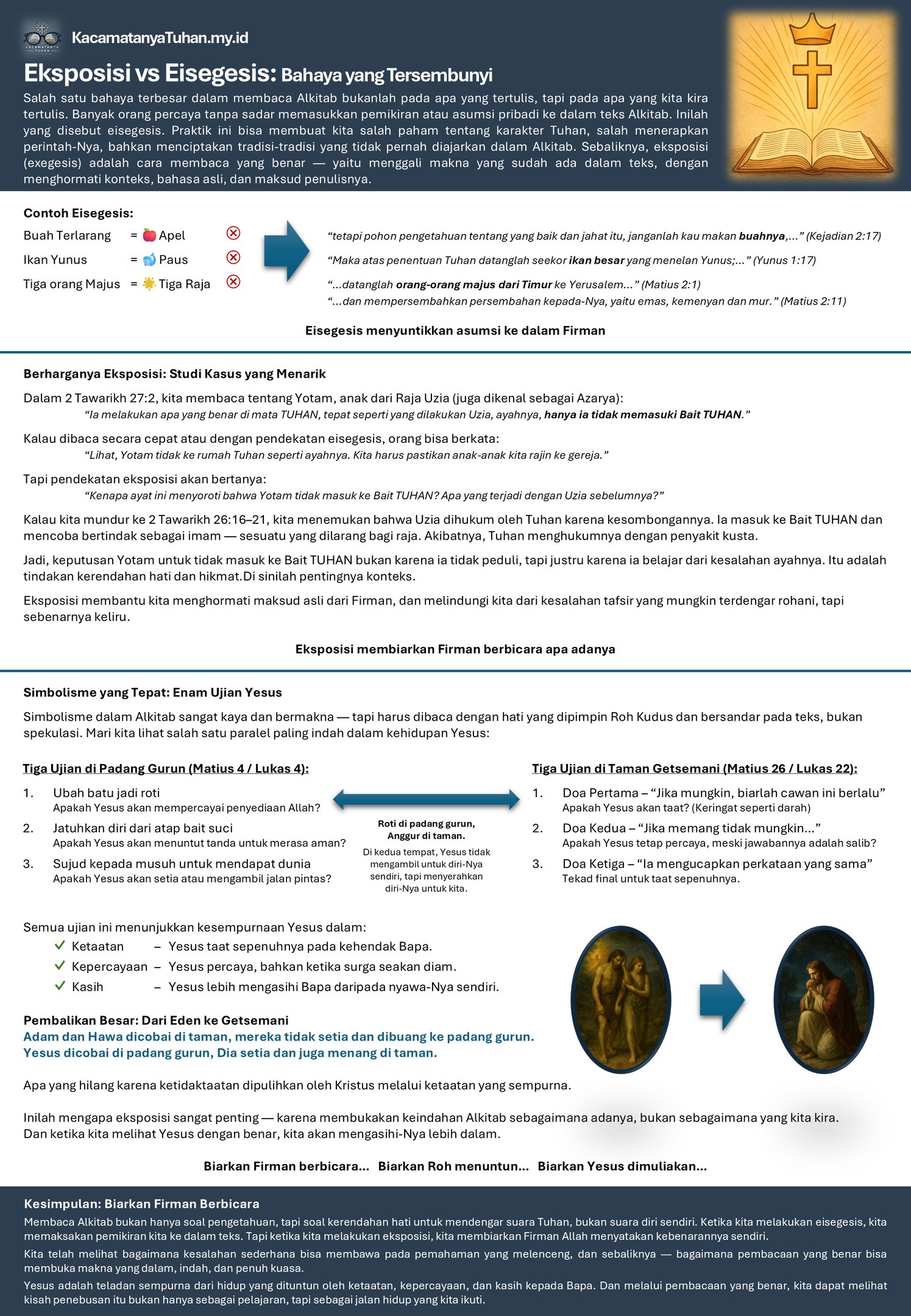
🍎 Forbidden Fruit = Apple
Many people think that the forbidden fruit in the Garden of Eden is an apple. In fact, in the original Hebrew text it is only called "fruit" (peri, פְּרִי), without the type description. The assumption about apples emerged later from Western art and culture, not from the Bible itself.
🐋 Yunus Fish = Whale
We often hear that Jonah was swallowed by a whale. But in Yunus 1:17, the original text only mentions "big fish" (dag gadol, דָּג גָּדוֹל). The Bible does not mention a specific type. Calling it a whale is a human guess, not the content of the text.
🌟 Three Magi = Three Kings from the East
Christmas is often associated with three magi bringing gold, incense, and myrrh. But the Bible (Matthew 2:1-12) never called them kings, nor did they number. The so-called are only "the wise men of the East" and three types of offerings. So the assumption that there are three kings is an addition to tradition, not from the original text.
These examples show that what we hear or imagine, is not necessarily in accordance with what the Bible really says.
Eisegesis injects assumptions into the Word.
The exposition allows the Word to speak as it is.
The Value of Exposition: An Interesting Case Study
In 2 Chronicles 27:2, we read about Jotam, the son of King Uzziah (also known as Azariah):
"He did what was right in the eyes of the LORD, just as Uzziah, his father did, only he did not enter the Temple of the LORD."
If read quickly or with an eisegesis approach, people can say:
"Look, Yotam did not go to God's house like his father. We have to make sure our children go to church diligently."
But the exposition approach will ask: "Why does this verse highlight that Jotam did not enter the Temple of the LORD? What happened to Uzia before?”
If we go back to 2 Chronicles 26:16–21, we find that Uzziah was punished by God for his arrogance. He entered the Temple of the LORD and tried to act as a priest — something forbidden to the king. As a result, God punished him with leprosy.
So, Yotam's decision not to enter the Temple of GOD was not because he did not care, but because he learned from his father's mistakes. It is an act of humility and wisdom.
This is where context is important.
Exposition helps us respect the original meaning of the Word, and protects us from misrepresentations that may sound spiritual, but are actually wrong.
The Right Symbolism: Six Tests of Jesus
Symbolism in the Bible is very rich and meaningful - but it must be read with a heart led by the Holy Spirit and based on the text, not speculation.
Let's look at one of the most beautiful parallels in the life of Jesus:
Three Tests in the Desert (Matthew 4 / Luke 4):
Turn a stone into bread - Will He trust God's provision?
Fall from the roof of the temple – Will He demand a sign to feel safe?
Prostrate to the enemy to get the world - Will He be faithful or take a shortcut?
Three Trials in the Garden of Gethsemane (Matthew 26 / Luke 22):
First Prayer – “If possible, let this cup pass” — Will He obey? (Sweat like blood = wine)
Second Prayer - "If it is impossible..." - Does He still believe, even though the answer is the cross?
The Third Prayer – “He spoke the same words” — The final determination to obey completely.
Bread in the wilderness, wine in the garden.
In both places, Jesus did not take for Himself, but gave Himself for us.
All these tests show the perfection of Jesus in:
Obedience - He obeys completely the Father's will.
Belief - He believes, even when heaven seems to be silent.
Love - He loves the Father more than His own life.
Great Reversal: From Eden to Getsemane
Adam and Eve were tempted in the garden and thrown into the desert.
Jesus was tempted in the desert and won in the garden.
What is lost due to disobedience is restored by Christ through perfect obedience.
This is why exposition is so important — because it exposes the beauty of the Bible as it is, not as we think. And when we see Jesus properly, we will love Him more deeply.
Conclusion: Let the Word Speak
Reading the Bible is not only about knowledge, but about humility to hear God's voice, not your own voice. When we do eisegesis, we force our thoughts into the text. But when we do exposition, we let the Word of God reveal its own truth.
We have seen how simple mistakes can lead to a misinterpreted understanding, and vice versa — how correct reading can open up deep, beautiful, and powerful meanings.
Jesus is the perfect example of a life guided by obedience, trust, and love for the Father. And through the correct reading, we can see the story of redemption not only as a lesson, but as a way of life that we follow.
Let the Bible shape our hearts.
Let the Holy Spirit guide our minds.
And let Jesus be the center of all our understanding.